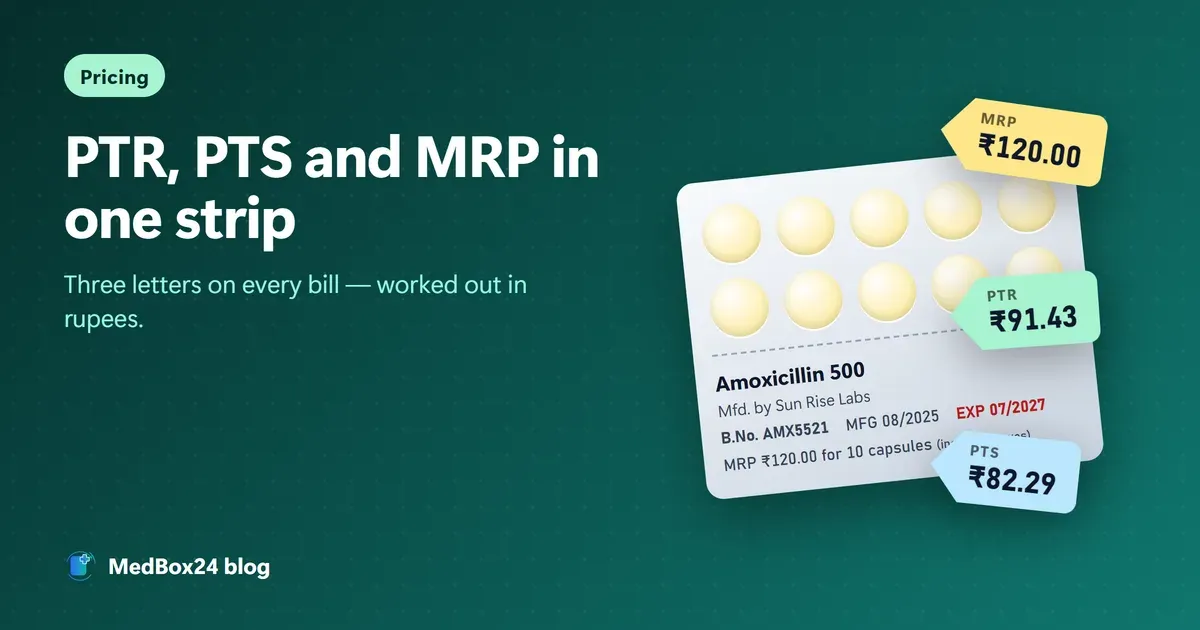
Every purchase bill from your distributor has a column called PTR. Every price list from a company has a PTS. The strip itself only shows the MRP. If you are new to the trade, these three letters can feel like a code everyone else already knows.
They are simpler than they look. Here they are, worked out on one strip.
The three prices
MRP — Maximum Retail Price. The most anyone can charge the customer. It is printed on the pack and it already includes GST.
PTR — Price to Retailer. What you, the chemist, pay the distributor for the strip, before GST.
PTS — Price to Stockist. What the distributor (stockist) pays the company, before GST.
The gap between MRP and PTR is your margin. The gap between PTR and PTS is the distributor's.
Worked out on one strip
Say a strip has an MRP of ₹120 and the medicine carries 5% GST. The company tells the trade: "20% retailer margin, 10% stockist margin". This is how everyone gets their price:
MRP without GST: ₹120 ÷ 1.05 = ₹114.29
PTR: take 20% off that — ₹114.29 × 0.80 = ₹91.43
PTS: take 10% off the PTR — ₹91.43 × 0.90 = ₹82.29
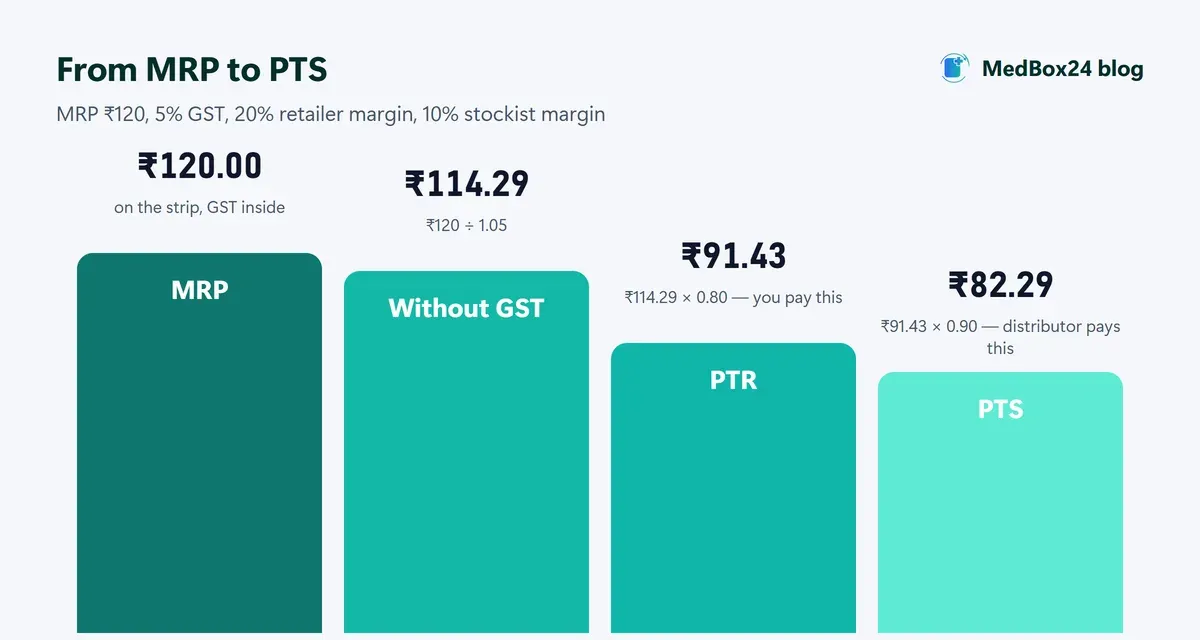
When you sell the strip at full MRP, you earn ₹114.29 − ₹91.43 = ₹22.86. The distributor earned ₹91.43 − ₹82.29 = ₹9.14 when they sold it to you. You can try your own numbers in our PTR and PTS calculator.
Why GST is taken out first
A common mistake is to take 20% off the full ₹120 and expect a PTR of ₹96. That would make you pay more than you should — and if you calculate your own margin this way, you will think you earn more than you do.
GST is not part of anyone's margin. It is collected at each step and passed on to the government. So every margin in the trade is worked out on the price without GST.
"16%" on scheduled medicines is counted differently
For medicines under price control (DPCO 2013), the government fixes a ceiling price that includes a 16% margin for the retailer. That 16% is added on top of the PTR, not taken off the MRP. So on a scheduled medicine your share of the sale is 16 ÷ 116 = about 13.8%. We worked this out with rupees in how much a medical store really earns.
Same word, "margin", two different ways of counting. When a salesman says "20% margin", ask whether it is 20% off the MRP without GST, or 20% on the PTR. The difference on a ₹114 sale is about ₹4 — on every strip.
Schemes change your real PTR
Distributors often offer schemes instead of a lower rate: 10+1, 5+1, or a cash discount for paying early. Here is what they do to the same strip:
Deal | You pay for | You get | Real cost per strip |
|---|---|---|---|
Normal | 10 × ₹91.43 = ₹914.30 | 10 strips | ₹91.43 |
10+1 scheme | ₹914.30 | 11 strips | ₹83.12 |
2% cash discount, paid in 7 days | ₹896.01 | 10 strips | ₹89.60 |
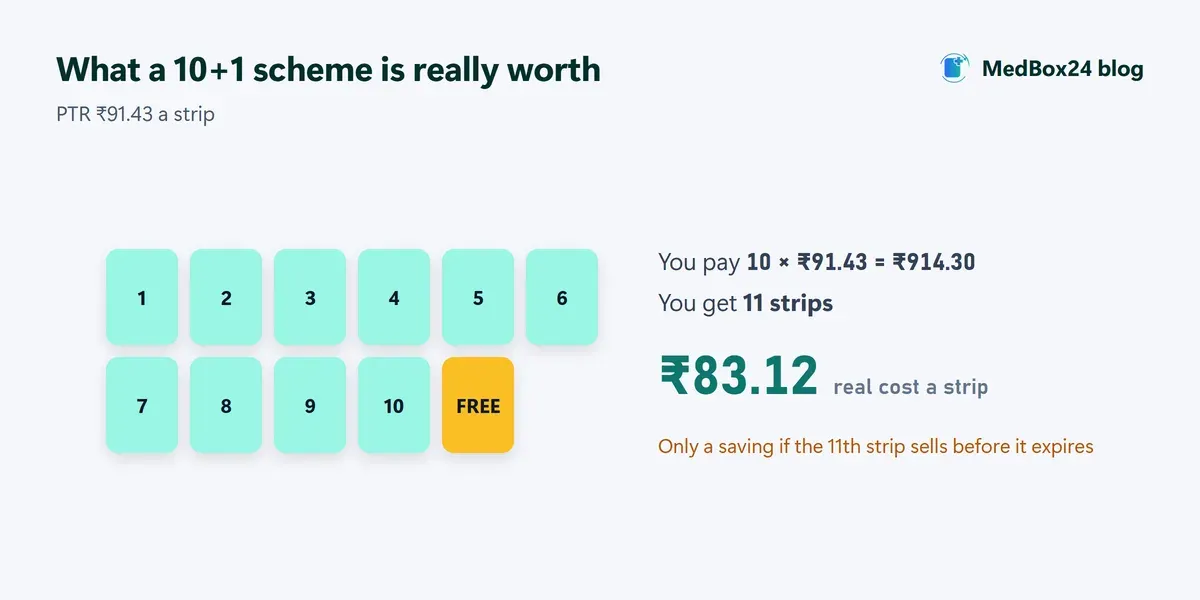
A scheme is only a good deal if you sell the extra strip before it expires. 11 strips of a medicine you sell twice a month is not ₹8 saved per strip — it is money stuck on the shelf, and maybe a strip that goes back as expiry. Take schemes on what moves fast; pay the normal rate for the rest.
What to check on every purchase bill
The PTR matches what you agreed. Rates change; a salesman's promise does not always reach the billing desk.
The free goods are actually on the bill — as quantity with zero value, not a verbal "next time".
The MRP on the bill matches the MRP on the strip. If the company has changed the MRP, your selling price must follow the strip, not your old records.
The GST rate is right. Most medicines have carried 5% since 22 September 2025. See what GST 2.0 changed for chemists.
Once PTR, PTS and MRP stop being letters and start being rupees, every scheme, every discount and every rate change becomes easy to judge — before you sign the bill, not after.
Run your medical store on MedBox24
Billing, stock, expiry, GST and payroll — on phone and computer. Free trial, no card.
Start free trial