"Medical store mein 20% margin hota hai." You will hear this from relatives, from the distributor's salesman, maybe from the person selling you the shop. It is not wrong. It is just not the number that ends up in your pocket.
This post works it out the way your accountant would: one strip first, then a whole month. The numbers are an example — your area, rent and product mix will change them — but the method works for every store.
Start with one strip
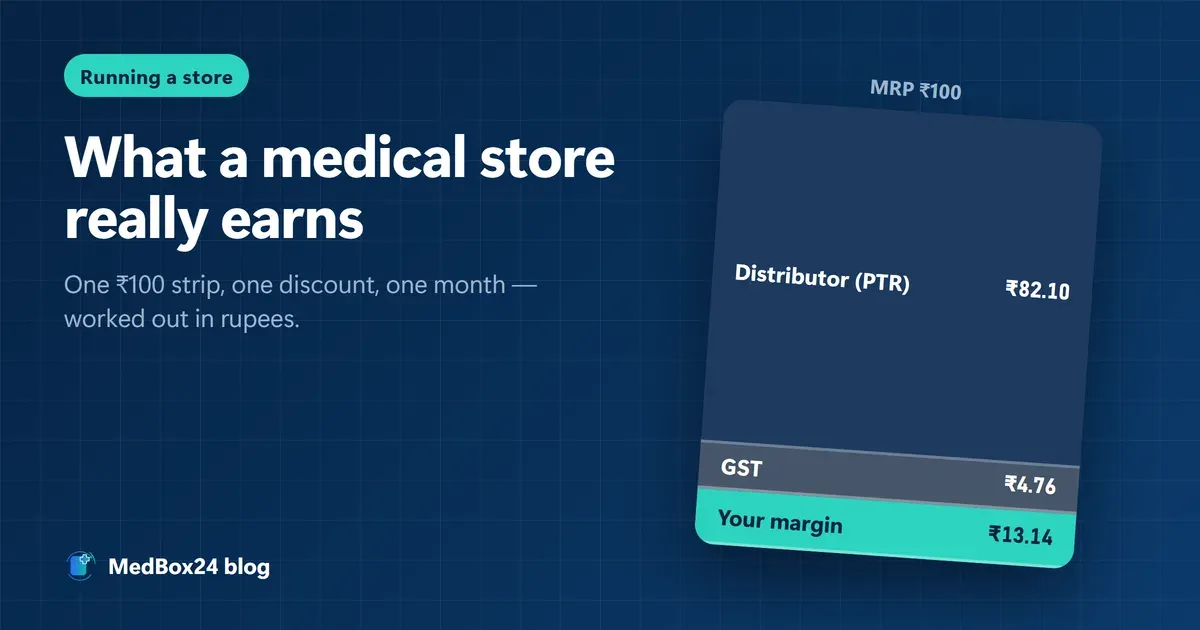
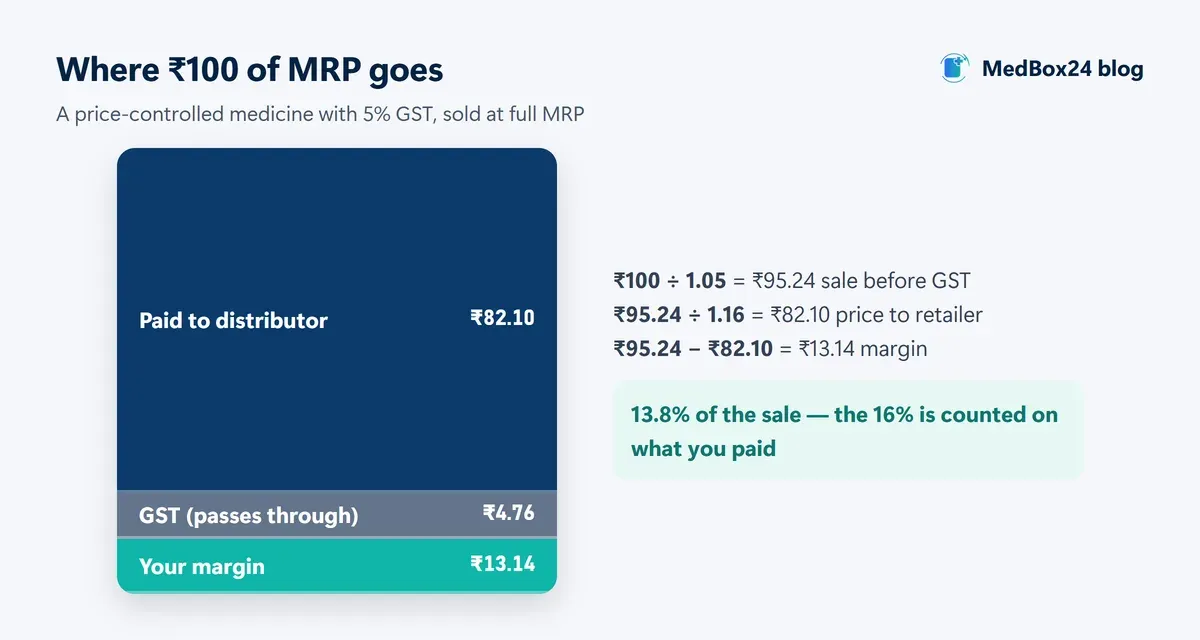
Take a common medicine that is under price control (a "scheduled" formulation under DPCO 2013). Its MRP is ₹100, and that already includes 5% GST.
Take the GST out: ₹100 ÷ 1.05 = ₹95.24. That is your sale before tax.
The price control order builds a 16% retailer margin into the ceiling price, on top of the price to retailer (PTR). So PTR = ₹95.24 ÷ 1.16 = ₹82.10.
Your margin on that strip: ₹95.24 − ₹82.10 = ₹13.14.
₹13.14 out of ₹100. On the sale before tax, that is 13.8% — not 16%, and certainly not 20%. The "16%" is counted on what you paid, not on what the customer pays. Most people mix these two up.
What about the GST? You collect ₹4.76 from the customer and you paid ₹4.11 to the distributor. The difference, about 66 paise, goes to the government. GST passes through you; it is never your income.
Not every medicine pays the same
A store sells four very different kinds of things, and each has its own margin:
What you sell | Typical margin on the sale before GST | Why |
|---|---|---|
Price-controlled (scheduled) medicines | about 13–14% | Fixed by DPCO, as worked out above |
Other branded medicines | often 16–20% | The company sets the PTR; it varies brand to brand |
Trade generics | can be 30% or more | Low PTR, but you must trust the maker and the distributor |
OTC, FMCG, devices | 10–25% | Depends on the product and how many you buy |
So when someone quotes "20%", ask: 20% on what, and on which shelf? A store whose sales are mostly chronic prescriptions from big brands will earn a lower average than one that also sells generics, baby care and devices. Our pharmacy margin calculator does this for any PTR and MRP you type in.
The discount problem
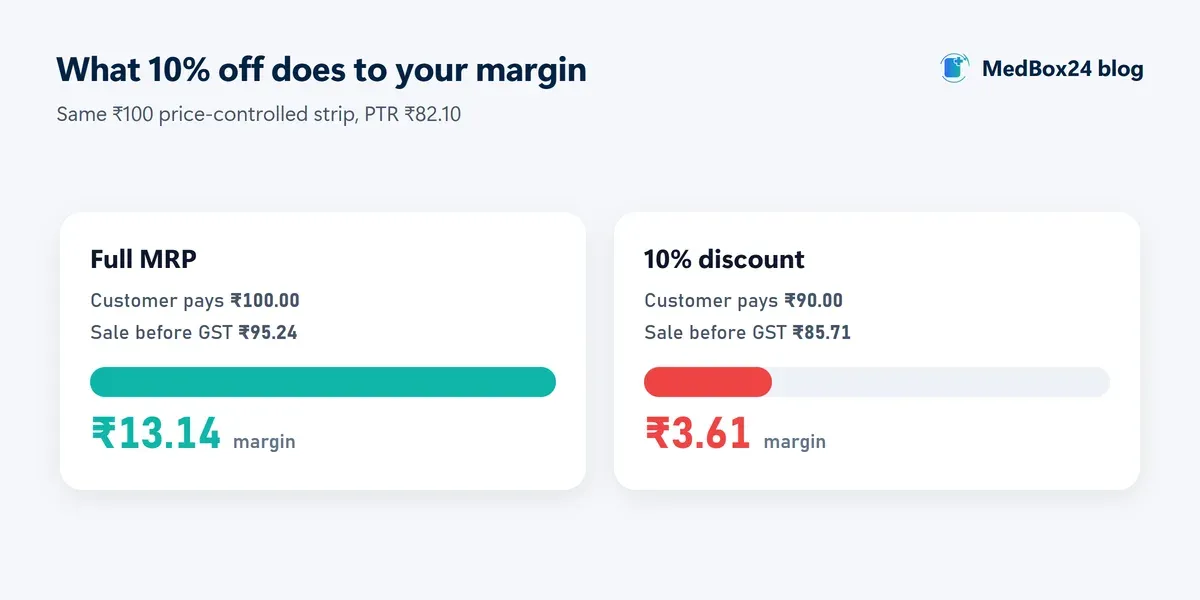
Customers ask for a discount on medicines all the time, and online pharmacies have made it worse. Here is what a flat 10% off does to the same ₹100 strip:
The customer pays ₹90, so your sale before GST becomes ₹90 ÷ 1.05 = ₹85.71.
You still paid ₹82.10 for it.
Your margin drops from ₹13.14 to ₹3.61.
A 10% discount did not cut your profit by 10%. It cut it by about 73%. On a price-controlled medicine, a 15% discount means you are selling at a loss.
This is why stores that give "flat 15% on everything" quietly push generics and their own deals: that is the only shelf where the discount still leaves something.
Now a whole month
Let us take a neighbourhood store selling about ₹20,000 a day — ₹6 lakh a month including GST. That is ₹5,71,429 before GST. Say the product mix and the discounts given leave an average margin of 17% on that.
Line | Per month |
|---|---|
Sales before GST | ₹5,71,429 |
Gross margin (17%) | ₹97,143 |
Rent | − ₹25,000 |
Registered pharmacist | − ₹20,000 |
Helper at the counter | − ₹12,000 |
Electricity (fridge, lights, fan or AC) | − ₹6,000 |
Expiry and breakage (1% of sales) | − ₹5,714 |
Phone, internet, software, bags, small costs | − ₹3,000 |
Left for the owner, before income tax | ₹25,429 |
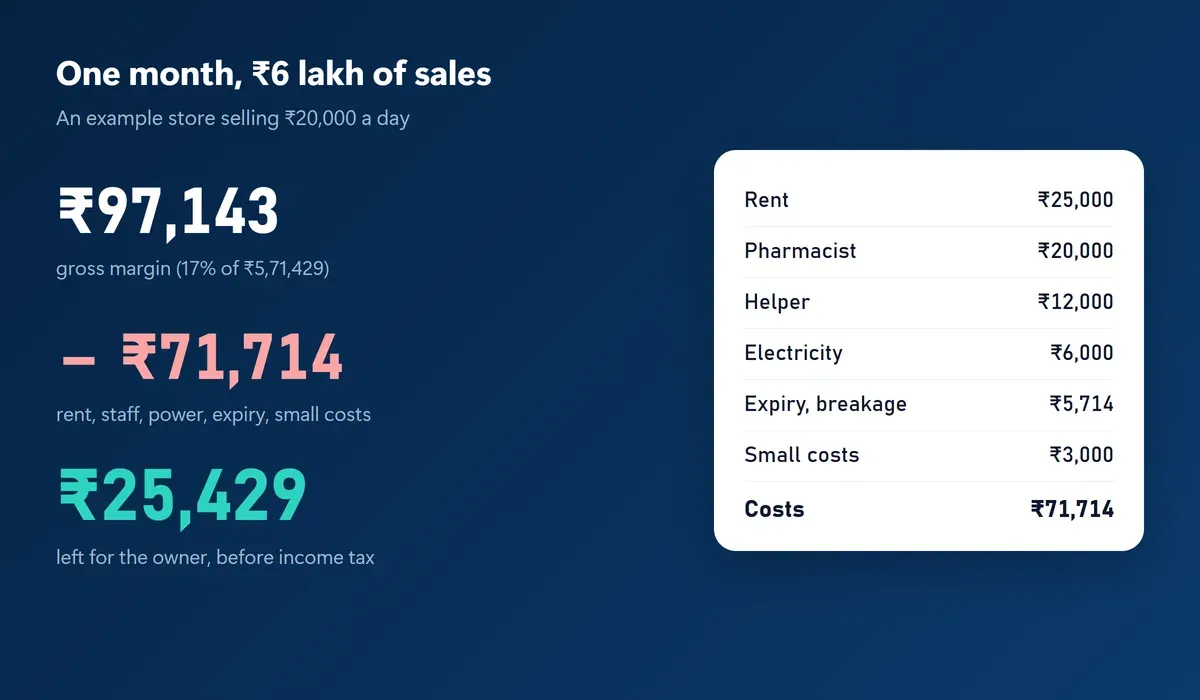
Two things change this table more than anything else:
If you are the pharmacist yourself, the ₹20,000 salary stays with you, and you take home about ₹45,000.
If your rent is ₹50,000 because you are on a main road, half your profit is gone — unless that road brings you twice the sales.
Run the same table at ₹10 lakh a month and the owner keeps far more, because rent and salaries barely move while the margin grows. That is the real business of a medical store: costs are fixed, so every extra bill after a point is mostly profit.
Where the money quietly leaks
The table above assumes you lose only 1% to expiry. Many stores lose more, and never see it, because nobody adds it up:
Expired stock that was not returned to the distributor in time.
Udhaar that never comes back.
Wrong rates on bills — an old MRP, a GST rate that was not updated after September 2025.
Stock that walks out without a bill.
Each one is small on a single day. Over a year, together, they can take a month's profit. We wrote separately about selling near-expiry medicines before they become a loss and finding dead stock.
So, how much does a medical store earn?
At ₹6 lakh of monthly sales, with average rent and one paid pharmacist, the owner keeps roughly ₹25,000–45,000 a month. At ₹10 lakh and above, a well-run store does much better. Below ₹3 lakh, with paid staff and high rent, it is hard to make anything at all.
Before you open one, write this table with your own numbers — the rent you will actually pay, the sales the area can actually give. Our guide on how to open a medical store and the post on what it costs to open one help with the first half. The second half is just honest arithmetic, done every month.
Run your medical store on MedBox24
Billing, stock, expiry, GST and payroll — on phone and computer. Free trial, no card.
Start free trial