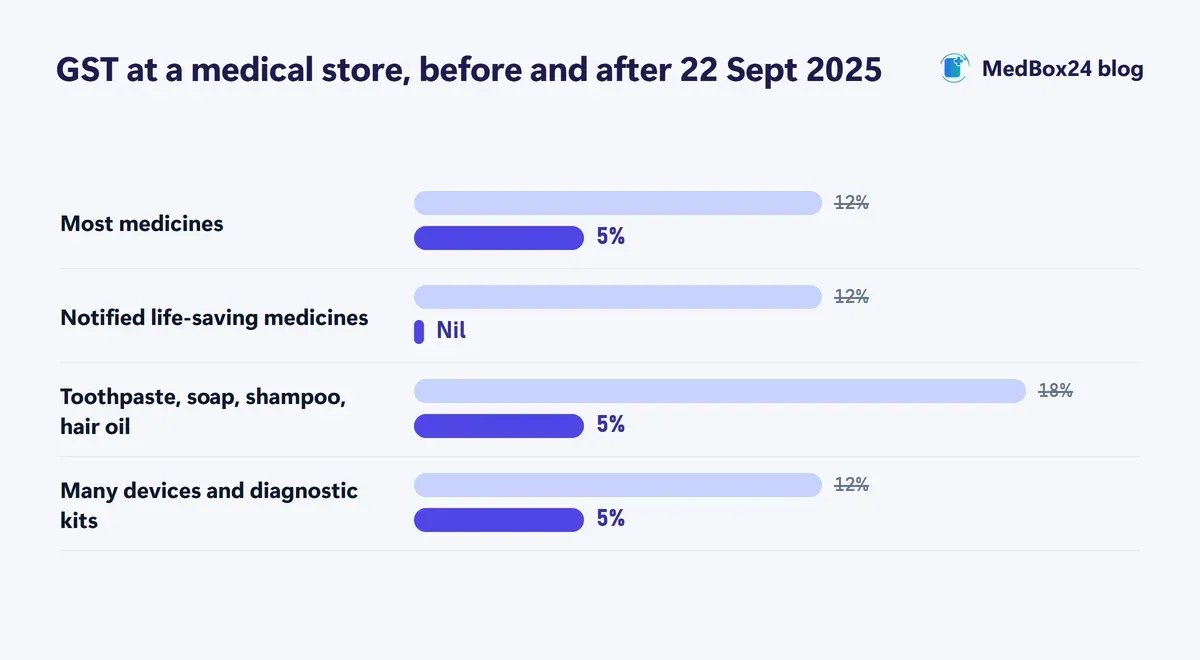
On 22 September 2025, the GST that a medical store charges changed more than it had in eight years. Most medicines went from 12% to 5%. A short list of life-saving medicines went to nil. Toothpaste, soap and shampoo — which half of all chemists sell next to the counter — dropped from 18% to 5%.
The change was good for customers. For the store, it left a mess to clean up: old stock with old MRPs, product masters with old rates, and bills that are quietly wrong if nobody updated them. Here is what changed and what to fix.
What changed
What you sell | GST before | GST from 22 Sept 2025 |
|---|---|---|
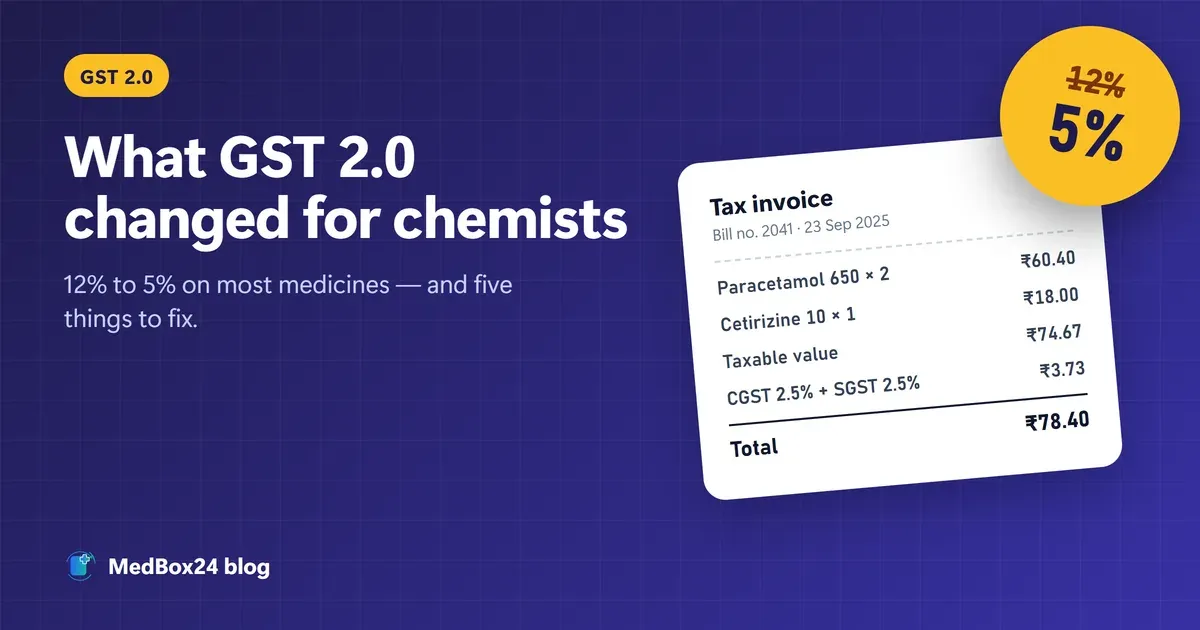
Most medicines (allopathic, ayurvedic, homeopathic) | 12% | 5% |
33 life-saving medicines (cancer, rare and serious chronic diseases) | 12% | Nil |
3 more life-saving medicines | 5% | Nil |
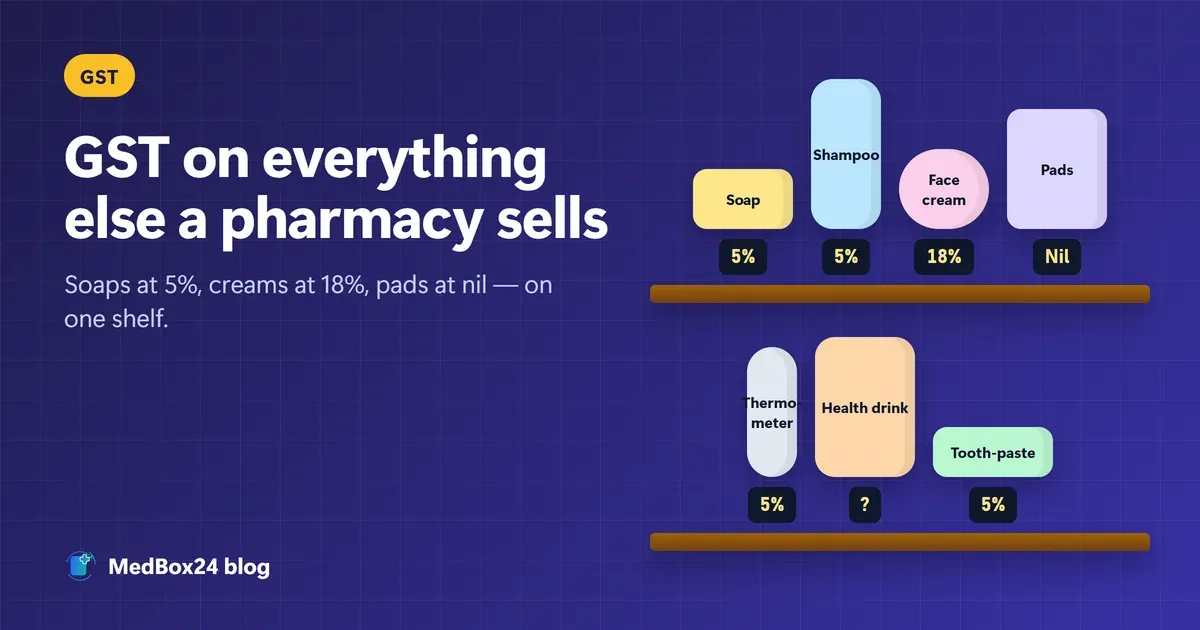
Toothpaste, soap, shampoo, hair oil, talcum powder | 18% | 5% |
Many medical devices and diagnostic kits | 12% or 18% | mostly 5% |
The rates came through Notifications 9/2025 and 10/2025 — Central Tax (Rate). For a product you are not sure about, the safest source is still your supplier's latest invoice: it carries the HSN code and the rate the supplier is charging. Our guide to GST on medicines explains HSN codes and how the tax inside an MRP is worked out.
What it means for an MRP
The MRP includes GST. When GST drops, the price the customer should pay drops too. Companies were told by the NPPA to pass the cut on from 22 September and to issue revised price lists; they did not have to recall or re-label the stock already in the market, and stickers with the new MRP were allowed.
So you may still have strips printed with the old MRP. Here is what the customer should pay for a strip printed at ₹112 with 12% GST:
Price without GST: ₹112 ÷ 1.12 = ₹100
Add 5% GST: ₹100 × 1.05 = ₹105
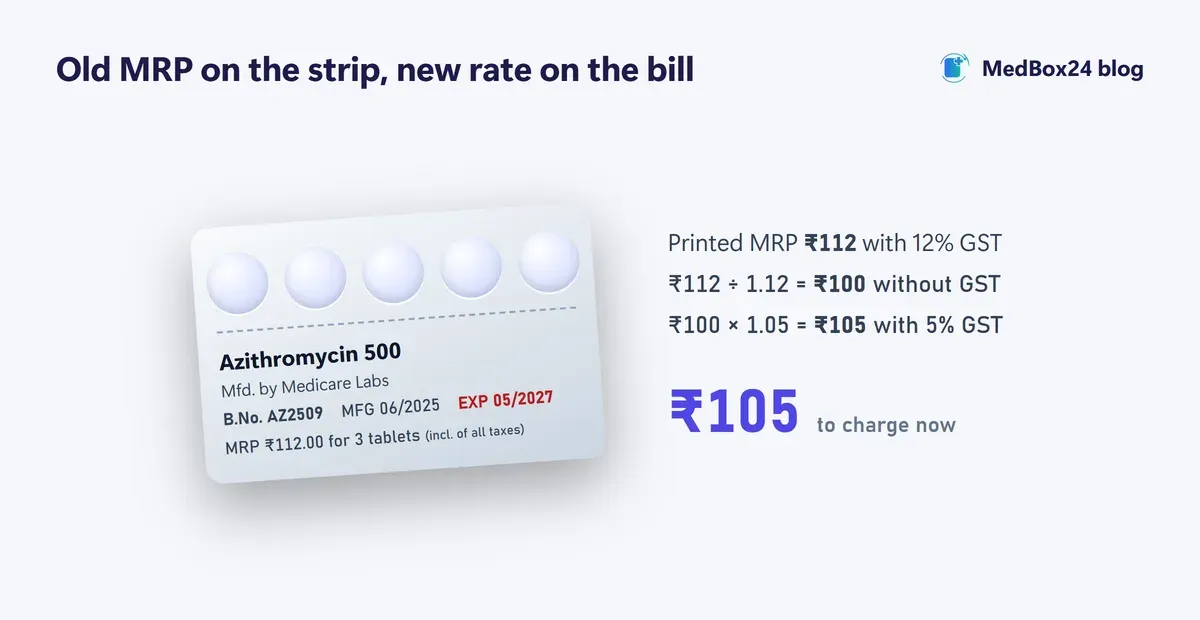
If your billing still charges ₹112 and adds 12% inside it, you are overcharging the customer by ₹7 — and paying the government ₹12 of tax on that strip when you should be paying ₹5. Both are wrong, and a sharp customer, or a GST officer, can catch either.
Five things to fix in your store
Update the GST rate on every product. Go through your product list category by category. Medicines to 5% (or nil for the notified list), personal care to 5%, cosmetics and other products as per the supplier's bill.
Use the revised price list for old stock. For strips still carrying the old MRP, sell at the revised MRP from the company's list or sticker. Keep those price lists in a file; they are your proof.
Check the first purchase bills after the change. Distributors' software had to be updated too. A purchase bill at the old rate means you claim the wrong input tax credit.
Look at returns. A strip sold before 22 September at 12% and returned after it should be returned at the rate it was sold at. Your credit note should match the original bill.
Check your first GST return after the change. The September return is where errors show up — sales at two rates in the same month, before and after the 22nd.
Did your margin change?
Not much, if everything was passed on correctly. Your margin is worked out on the price without GST. If the company kept the same price without GST and only the tax fell, your rupee margin stays the same, and the customer pays less.
Where stores lost money was on old stock bought at 12% and sold at the new lower MRP: the input credit on those purchases was higher than the output tax. That difference is usually adjusted in the GST return as input credit, not lost — but only if the purchase bills are recorded properly. If you are not sure, check with your accountant before you file.
A quick check you can do today
Pick ten products from different shelves — two medicines, one life-saving item, one soap, one shampoo, one device, one cosmetic, three random ones. Bill them in your software at full MRP and look at the GST on each line. If any line shows 12% or 18% where it should be 5%, your product master needs a full review.
It takes ten minutes. It might save you a notice later. And if you file your own returns, our post on GSTR-1 and GSTR-3B for a medical store covers the monthly routine.
Run your medical store on MedBox24
Billing, stock, expiry, GST and payroll — on phone and computer. Free trial, no card.
Start free trial