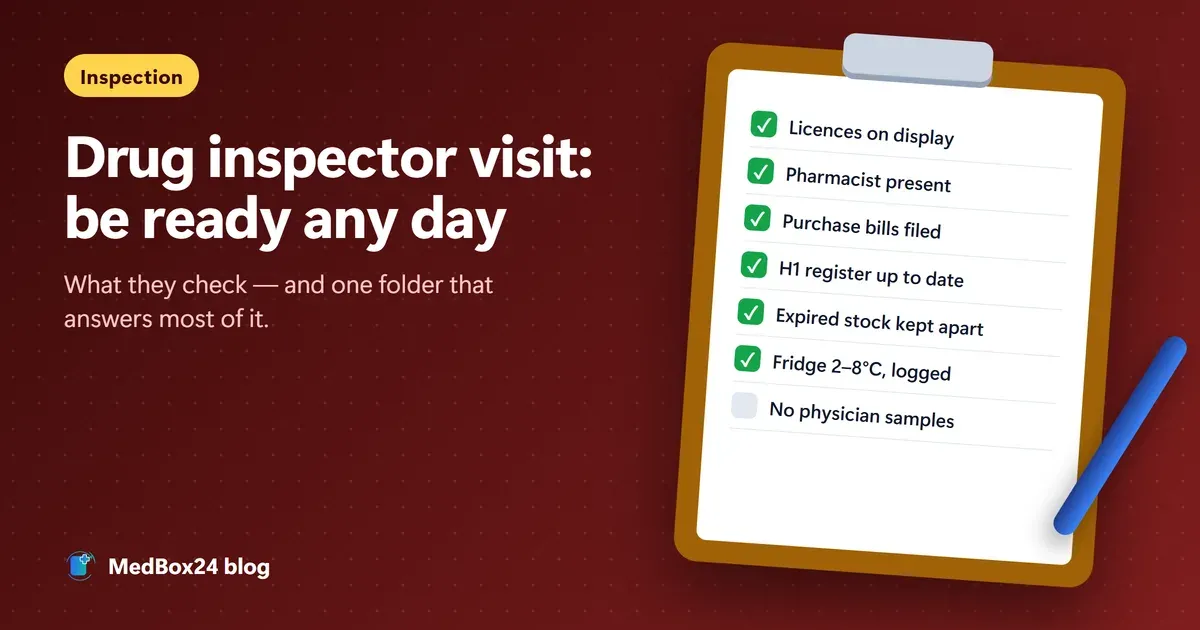
Drug inspectors rarely call before they come. They walk in on a Tuesday afternoon when the pharmacist has stepped out for tea, the H1 register is in the owner's bag, and a carton of expired syrup is sitting behind the counter waiting to be returned.
None of those things is a crime on its own. Together they make an inspection go badly. The good news is that what an inspector checks is not a secret, and it is the same in almost every state. Keep these things ready every day and an inspection becomes a short, boring visit — which is exactly what you want.
The licence and the pharmacist
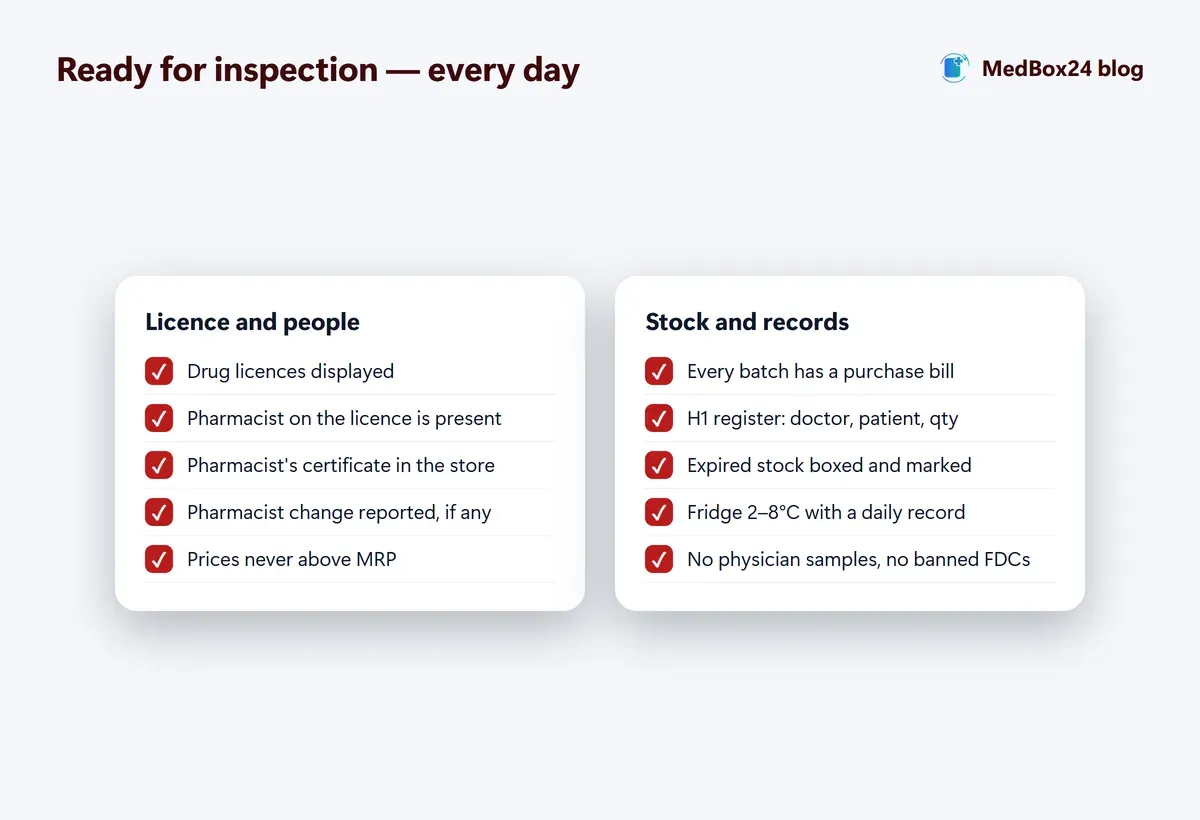
Your drug licences are displayed where customers can see them — usually Form 20 and Form 21, and Form 20F if you stock Schedule X.
The registered pharmacist named on the licence is present during working hours, with their registration certificate available. This is the first thing many inspectors ask: "Pharmacist kahan hain?"
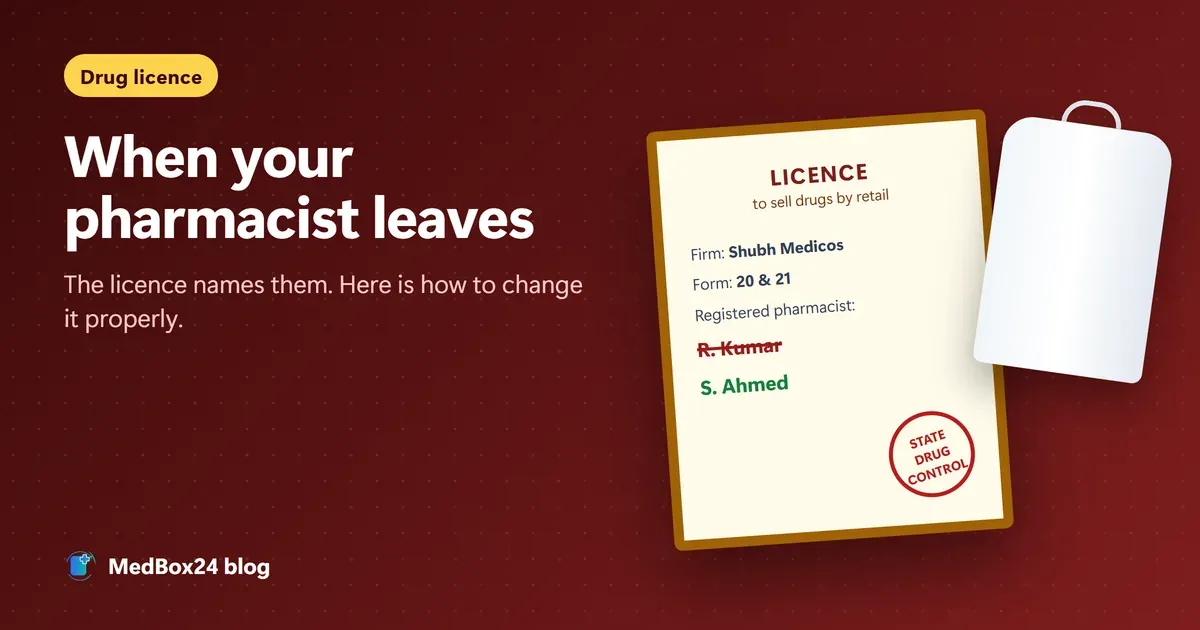
If the pharmacist has changed, the licensing authority has been told. A licence that still shows someone who left two years ago is a problem on its own; report a change as soon as it happens.
Purchases: where did this stock come from?
An inspector may pick a few products and ask for the purchase bill.
Every purchase is from a licensed wholesaler, on a proper bill with batch, expiry and the wholesaler's licence number.
Purchase bills are filed and easy to find, month by month.
No stock without a bill. Not from a friend's store, not "adjusted" by a salesman, not from an unknown supplier selling cheap.
If your purchases are entered in billing software with batch numbers, you can show the bill for any batch on the shelf in a few seconds.
Sales: prescriptions and registers
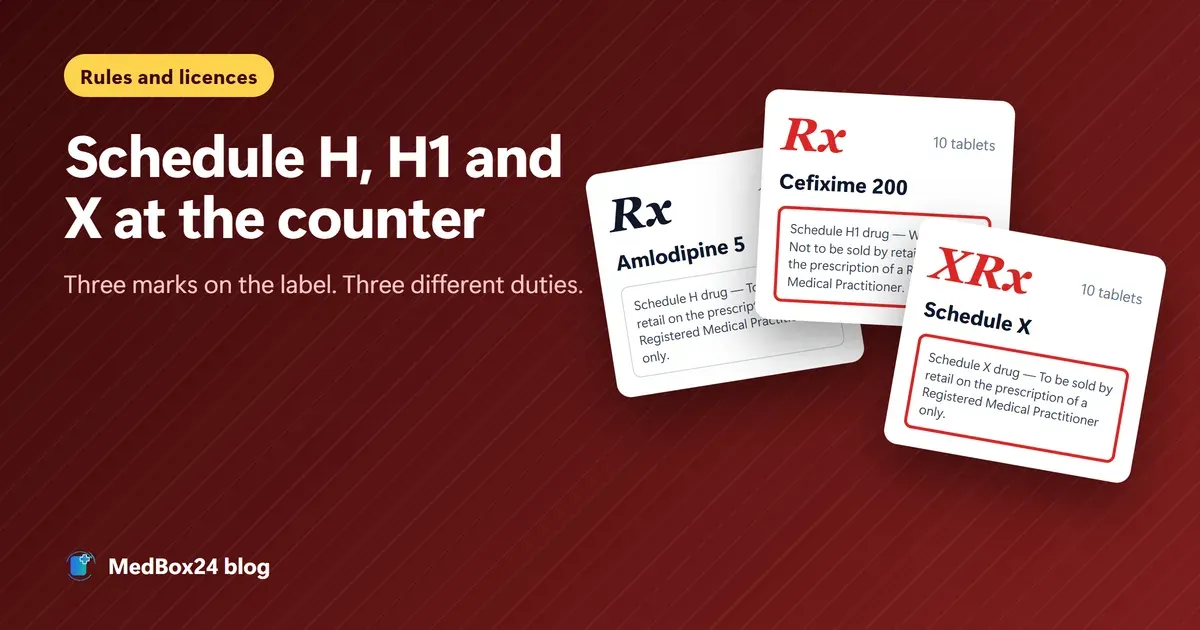
Schedule H and H1 medicines are sold only on prescription. Read Schedule H, H1 and X at the counter for the difference.
The H1 register is up to date — doctor, patient, medicine, quantity — and kept for three years. Our Schedule H1 register guide has the format.
Sale bills carry the batch number and expiry, so a sale can be traced back to a batch.
Nothing is sold above the MRP.
On the shelves
Expired medicines are separated in a box clearly marked "Expired — not for sale", away from saleable stock.
No physician samples — packs marked "Physician's sample, not to be sold" must not be in your stock.
No banned products. The government bans certain fixed-dose combinations from time to time. Check new ban notifications and remove those products.
Medicines that need cold storage are in the fridge, at 2–8°C, with a thermometer and a temperature record. See storing insulin and vaccines correctly.
The premises are clean and dry, with medicines off the floor and away from direct sunlight.
One folder that answers most questions
Make a single folder — paper or on the computer — with everything an inspector usually asks for:
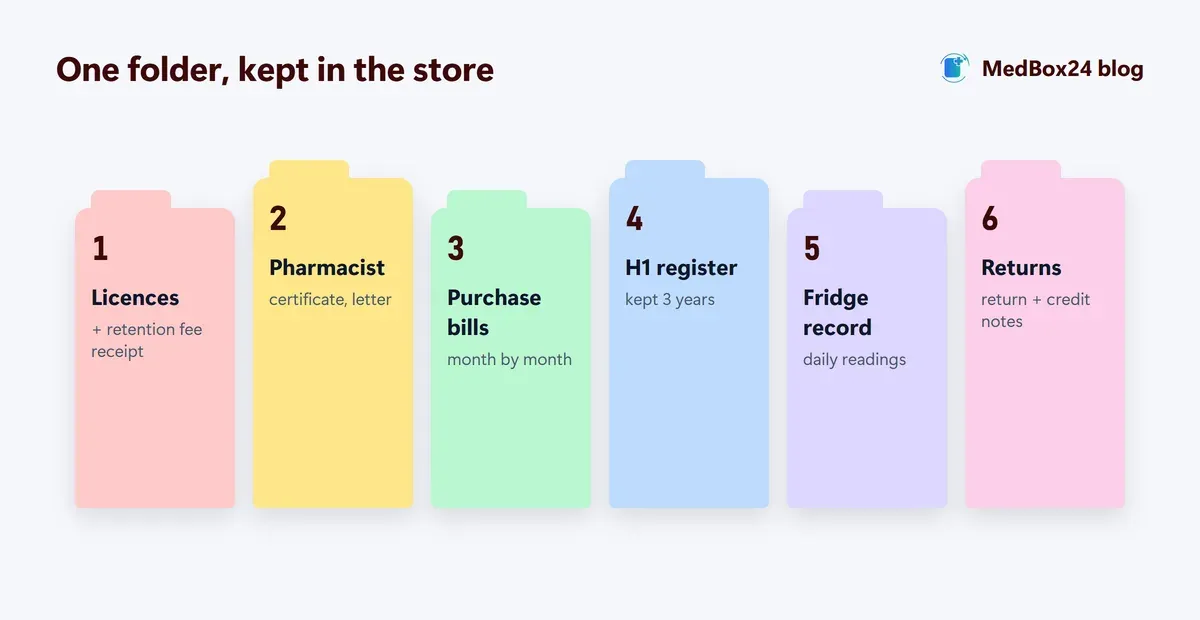
Copies of all drug licences and the latest retention-fee receipt.
The pharmacist's registration certificate and appointment letter.
Purchase bills, filed month by month.
The H1 register (and Schedule X records, if you stock them).
The fridge temperature record.
Return notes and credit notes for expired stock sent back.
Keep the folder in the store. "It is at home" is the answer inspectors hear most often, and the one they like least.
During the visit
Be polite, answer what is asked, and show what is asked for. Do not argue on the spot. If the inspector notes a deficiency, read the inspection report before you sign it, and ask for a copy. Most deficiencies come with time to fix them; fix them within that time and reply in writing.
The real secret
Stores that pass inspections easily are not stores that prepare for inspections. They are stores where the daily work — bills with batches, the H1 entry at the counter, expired stock out of the shelf every month — is simply done every day. Then there is nothing to prepare.
Run your medical store on MedBox24
Billing, stock, expiry, GST and payroll — on phone and computer. Free trial, no card.
Start free trial