Every strip in your store carries one of three quiet signals on its label. Most customers never notice them. A drug inspector notices nothing else.
Here is what Schedule H, H1 and X mean when a customer is standing in front of you — not in the language of the Drugs and Cosmetics Rules, 1945, but in what you actually have to do.
The short version
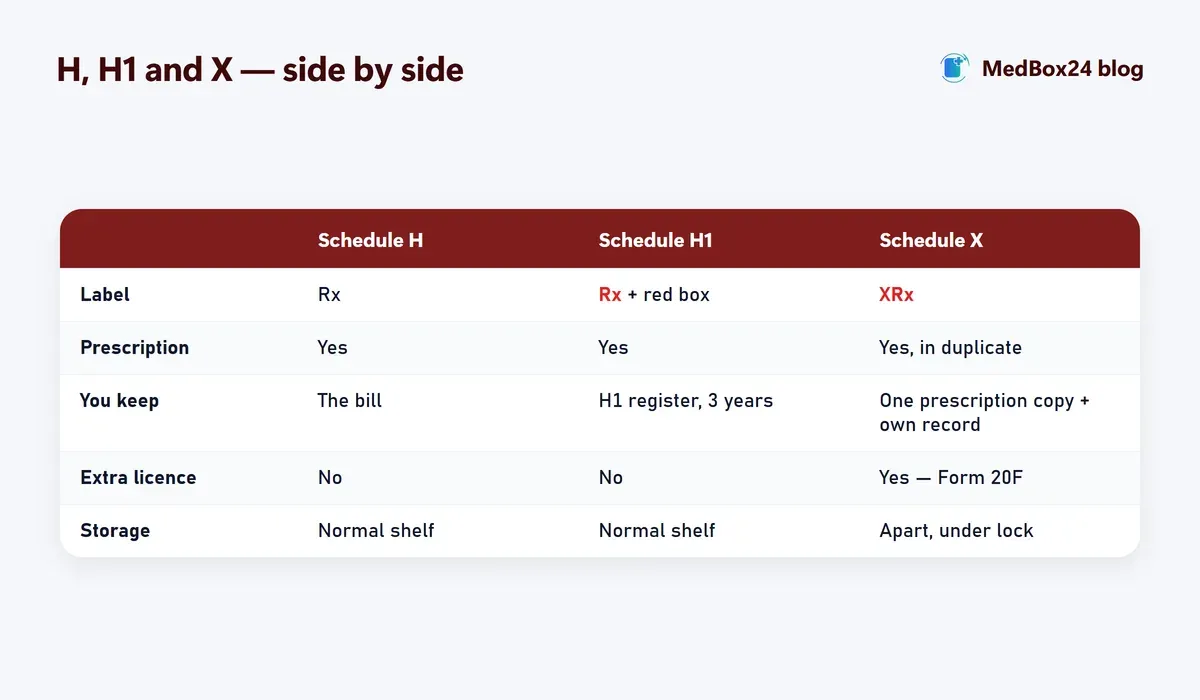
Schedule H | Schedule H1 | Schedule X | |
|---|---|---|---|
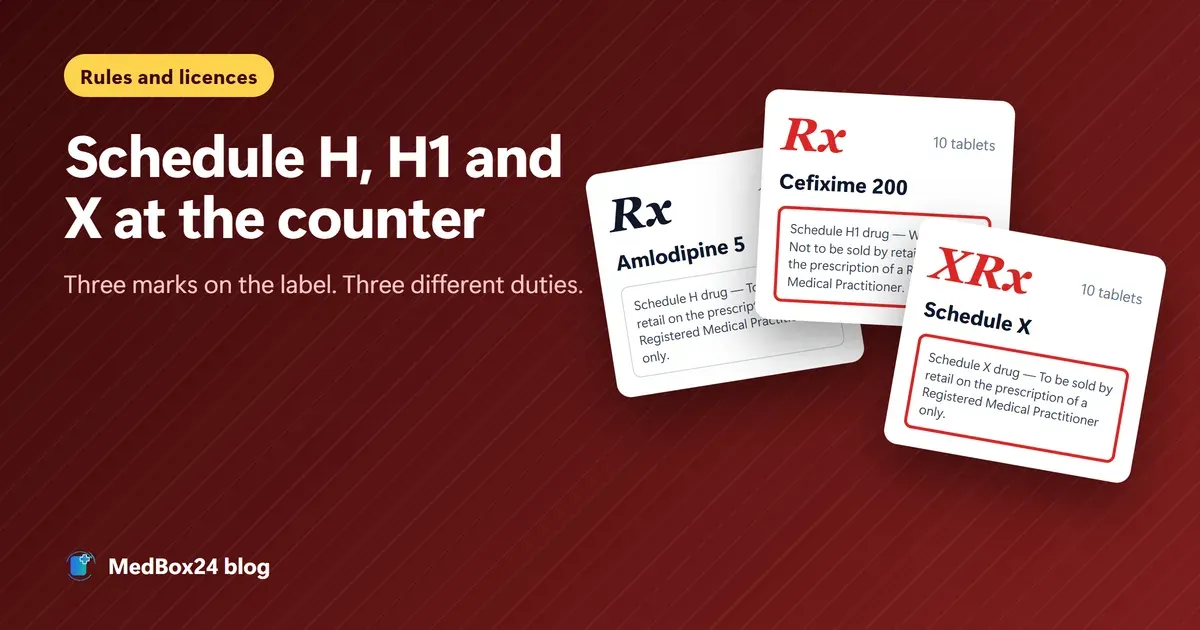
Mark on the label | Rx | Rx in red, warning in a red box | XRx in red |
Prescription needed? | Yes | Yes | Yes, and it must be in duplicate |
What you keep | The bill | An entry in the H1 register, kept 3 years | One copy of the prescription, and a separate record |
Extra licence? | No | No | Yes — a separate retail licence (Form 20F) |
Examples | Most antibiotics, BP and diabetes medicines, steroids | Cefixime, levofloxacin, alprazolam, tramadol, anti-TB medicines | A small list of strong narcotic and psychotropic substances |
Schedule H: the everyday prescription medicine
Most of what sits on your shelves is Schedule H. The label carries Rx and the line "To be sold by retail on the prescription of a Registered Medical Practitioner only."
At the counter that means one thing: no prescription, no sale. In real life, a regular patient on the same BP tablet for five years will not always bring the paper. Many stores keep a copy of the prescription on file for such patients and ask for a fresh one when the doctor changes the dose. That is the honest middle ground, and it protects you if anyone asks later.
Schedule H1: the one with the register
Schedule H1 came in on 1 March 2014. It covers medicines the government worried were being misused — newer antibiotics like cefixime, cefpodoxime, levofloxacin and moxifloxacin, anti-TB medicines like isoniazid and rifampicin, and habit-forming ones like alprazolam, zolpidem and tramadol. The original notification listed 46 substances.
You can spot them easily: the Rx is in red, and the warning sits inside a box with a red border.
For every H1 sale you must write down, in a separate H1 register:
the doctor's name and address,
the patient's name,
the medicine and the quantity sold.
The register has to be kept for three years and shown when an inspector asks. Our guide to the Schedule H1 register shows a ready format. If your billing software captures the doctor and patient on the bill, it can print the register for you — which is far easier than writing it by hand on a busy evening.
Schedule X: separate licence, separate shelf
Schedule X is a short list of narcotic and psychotropic substances with real potential for abuse. The label carries XRx in red.
Most neighbourhood stores never stock them, and that is fine. If you do:
you need a separate retail licence for Schedule X (Form 20F), in addition to your normal licence,
the prescription must be in duplicate, and you keep one copy,
the stock is kept apart from everything else, under lock,
every receipt and sale goes into its own record.
If you are not set up for all four, do not stock Schedule X at all. It is the quickest way to turn an ordinary inspection into a case. If you are not sure, leave it to stores that are.
At the counter: a 10-second check
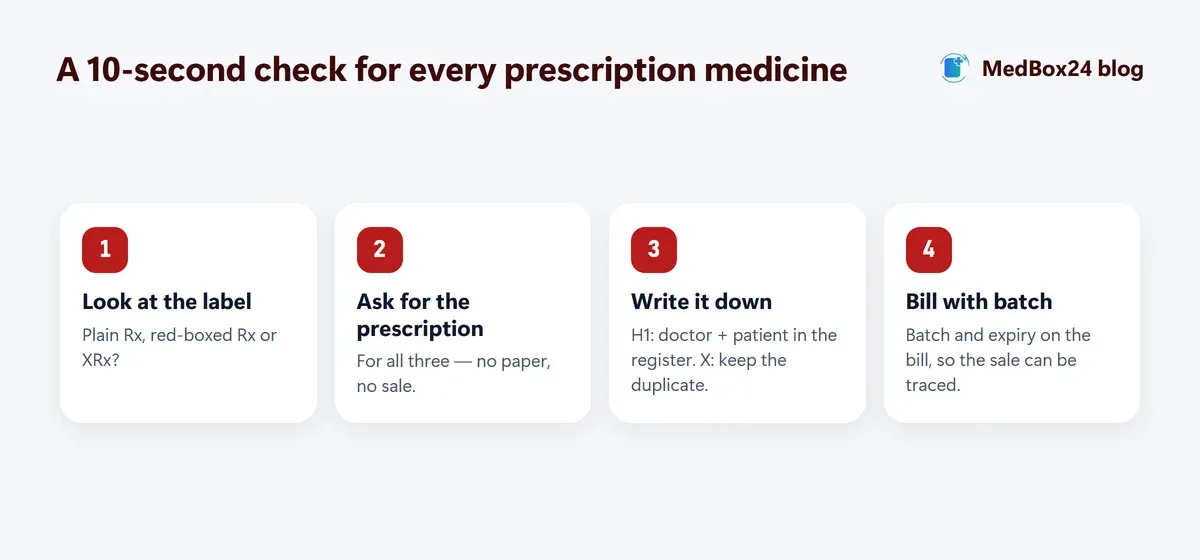
Look at the label. Plain Rx, red-boxed Rx or XRx?
Ask for the prescription. For any of the three.
For H1: note the doctor and patient. For X: keep the duplicate copy.
Bill it with the batch and expiry, so the sale can be traced later.
Train every person who stands at your counter to do this, not just the pharmacist. The rule applies to the store, and so does the penalty.
What changes next
The government has proposed more changes to Rule 65 in 2026, including CCTV over prescription-medicine sales. These are drafts, not law, at the time of writing. When a change is notified, we will update this post — and if you use MedBox24, you will see it in the app first.
Run your medical store on MedBox24
Billing, stock, expiry, GST and payroll — on phone and computer. Free trial, no card.
Start free trial