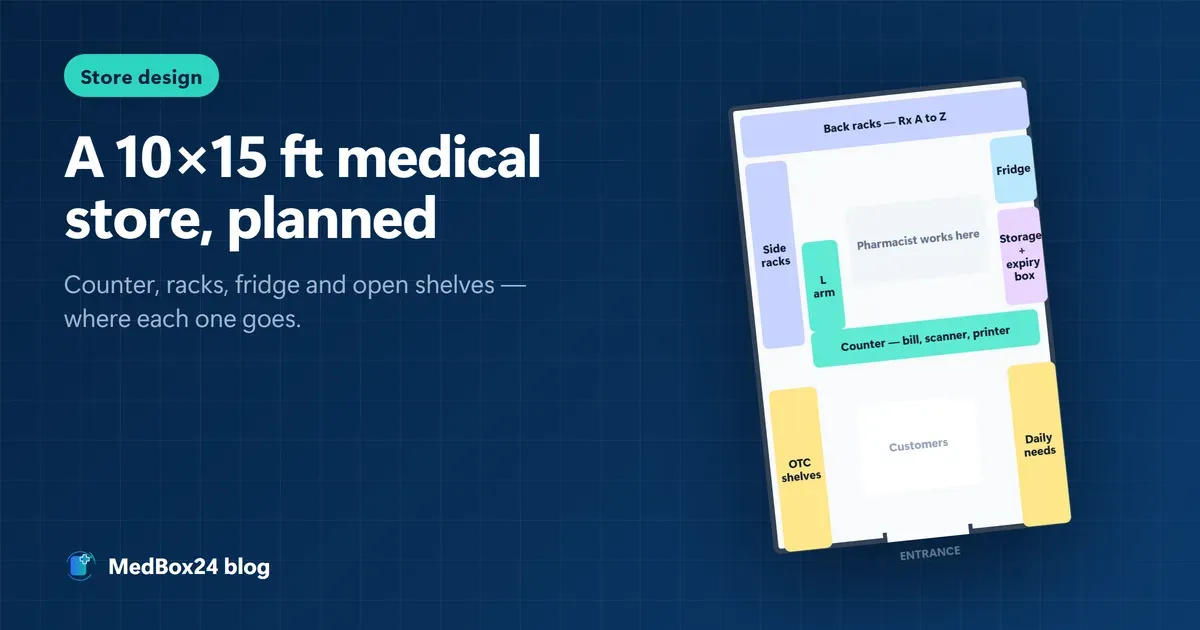
In a small medical store, the layout decides how fast you can bill. A pharmacist who walks three steps for every strip serves fewer customers an hour than one who turns around and reaches it. Multiply that by a thousand bills a month and the shape of the room matters more than the colour of the paint.
Here is a plan for a typical 10×15 ft shop, and the reasoning behind each part, so you can adapt it to your own space.
The counter: an L at the front
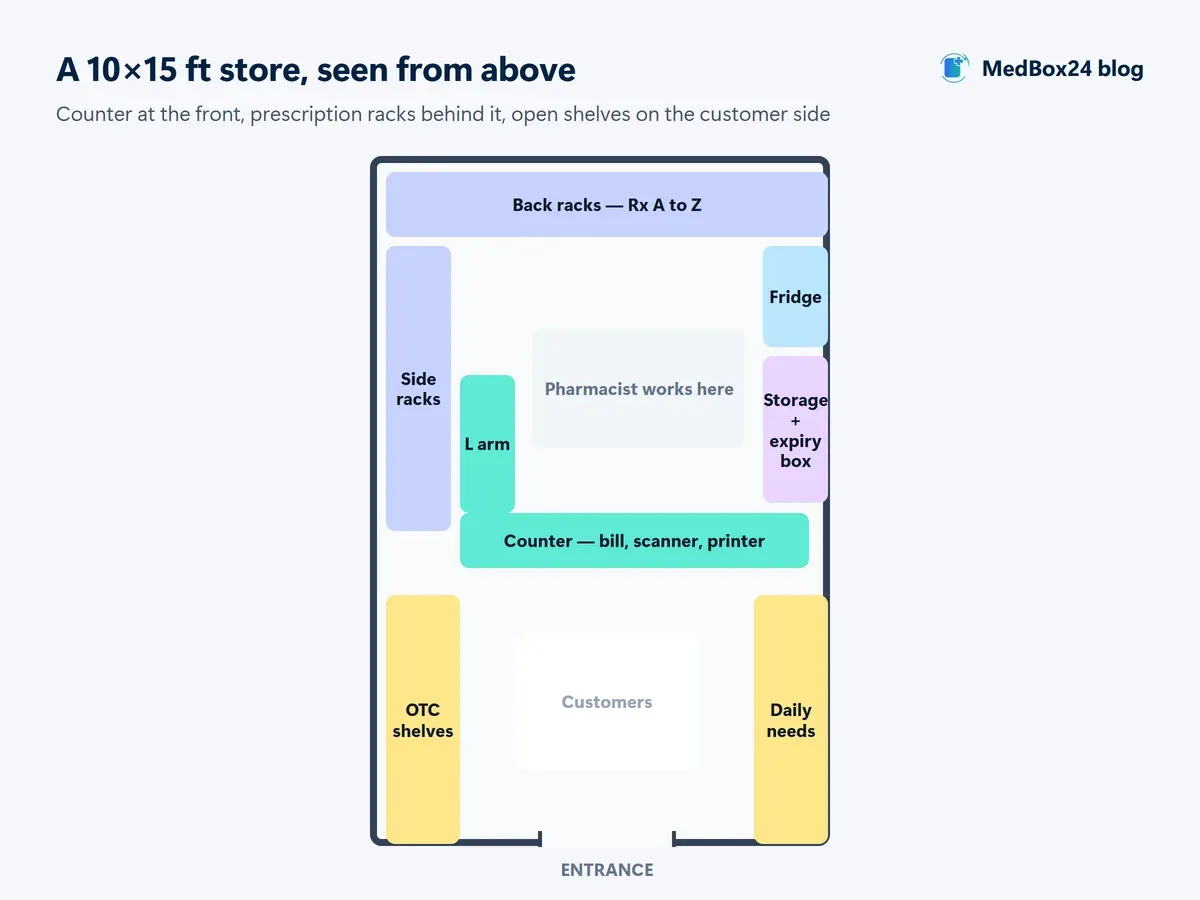
Put the counter across the front, with a short arm along one side to make an L. The long side is where customers stand and where the bill is printed. The short arm gives a second person room to work during the evening rush without bumping into the first.
Keep on the counter only what you use on every bill: the computer or tablet, the bill printer, the barcode scanner, a pen and the H1 register. Everything else goes under it.
Prescription racks behind the counter
Schedule H and H1 medicines must not be within the customer's reach, so they go on racks behind the counter, along the back and side walls.
How you arrange them is up to you, but pick one system and stick to it:
By type, then A to Z — tablets and capsules, syrups, drops, ointments, injections — and alphabetical within each. This is the easiest for new staff.
By company — some old stores do this because distributors deliver by company. It makes billing slower when a customer asks for a generic name.
Whatever you choose, number every rack and shelf — A1, A2, B1 and so on — and put the rack number against each product in your billing software. A new helper can then find anything from the screen, and you can count stock one rack at a time.
What goes at eye level
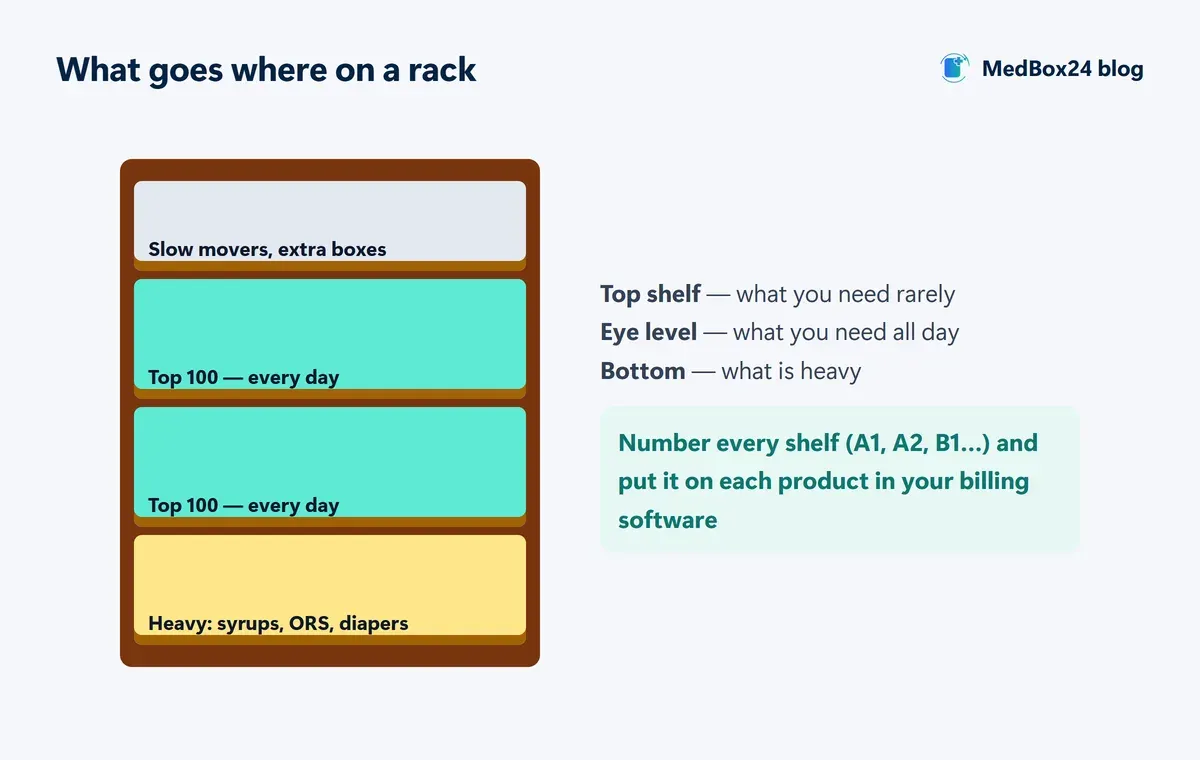
Top shelf: slow movers and extra boxes of fast ones.
Eye level and just below: the 100 or so products you sell every day. These should be reachable without a stool or a bend.
Bottom shelf: heavy and bulky items — big syrups, ORS cartons, adult diapers.
Look at your best-selling products once a quarter and make sure they are still at eye level. Prescribing habits change, and so should the shelf.
The fridge: near the counter, away from heat
Put the fridge where the pharmacist can reach it without leaving the counter, but not next to the window, the back of the inverter, or the wall that gets the afternoon sun. Leave a gap behind it for air. Keep a thermometer inside and a record next to it. Our post on storing insulin and vaccines explains why a fridge in the wrong place can quietly ruin stock.
Open shelves for OTC and daily needs
On the customer side, along the wall opposite the counter, put open shelves for things people like to pick up themselves: soaps, shampoos, baby care, sanitary pads, health drinks, bandages, devices like thermometers and BP machines. Put prices on the shelf edge.
This wall sells more than you expect. A customer waiting for their prescription picks up a toothpaste or a pack of diapers. Keep it full, clean, and lit.
Storage and the expiry box
At the back, keep a small closed area for extra cartons and for one clearly labelled box: "Expired / for return — not for sale." It must never be on a selling shelf.
Small things that matter
Light: bright white light over the counter and the racks. Pharmacists read tiny batch numbers all day.
Floor: nothing on the floor. Cartons on the floor get wet, get kicked, and look bad to an inspector.
Seating: one stool for an elderly customer. People remember it.
Camera: one camera over the counter. It protects you in a dispute and keeps everyone at the counter honest, including the owner.
A good layout is invisible. Customers just feel the store is quick and organised. Your staff feel it every evening at seven o'clock, when ten people are waiting and every strip is exactly where it should be.
Run your medical store on MedBox24
Billing, stock, expiry, GST and payroll — on phone and computer. Free trial, no card.
Start free trial