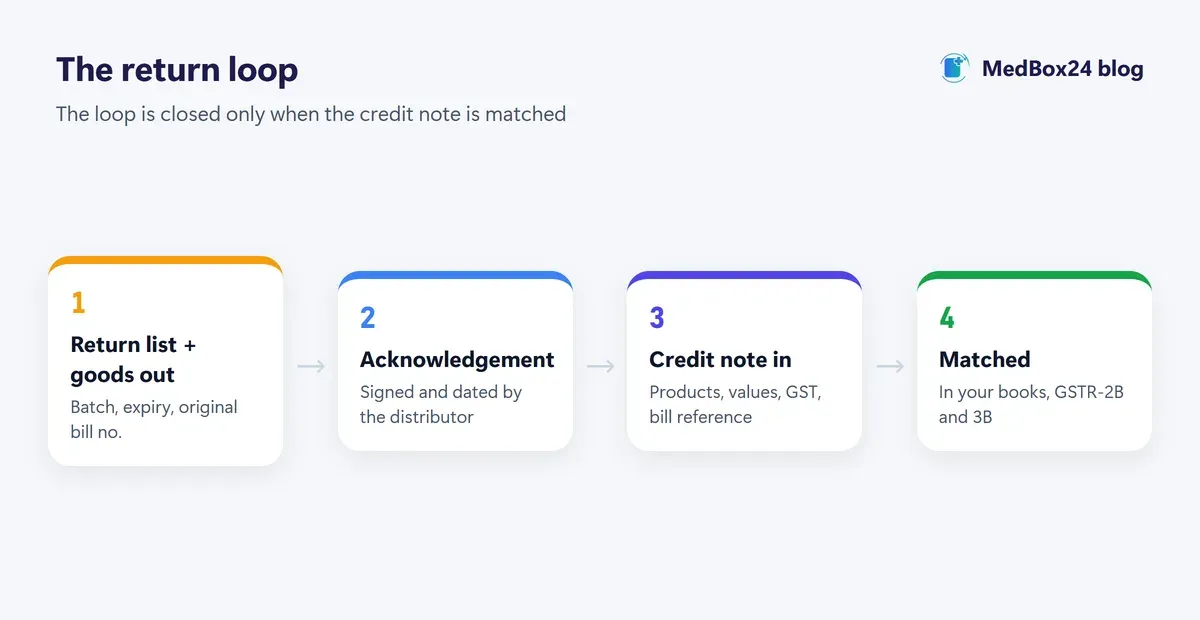
Returning expired stock to the distributor is half the job. The other half — the one many stores forget — is making sure the credit note comes back, for the right amount, and that your GST records match it.
A return without a credit note is the same as throwing the stock away. Here is how to close the loop.
Before you send the return
Know each distributor's terms. Most accept expired or near-expiry goods only within a window, only for stock bought from them, and sometimes with a deduction. Ask for the terms in writing.
Make a return list: product, batch, expiry, quantity, and the original purchase bill number for each line.
Separate by distributor. One box, one list, one distributor.
Get a signed acknowledgement when the return is collected — even a signature and date on your copy of the list.
What the credit note should show
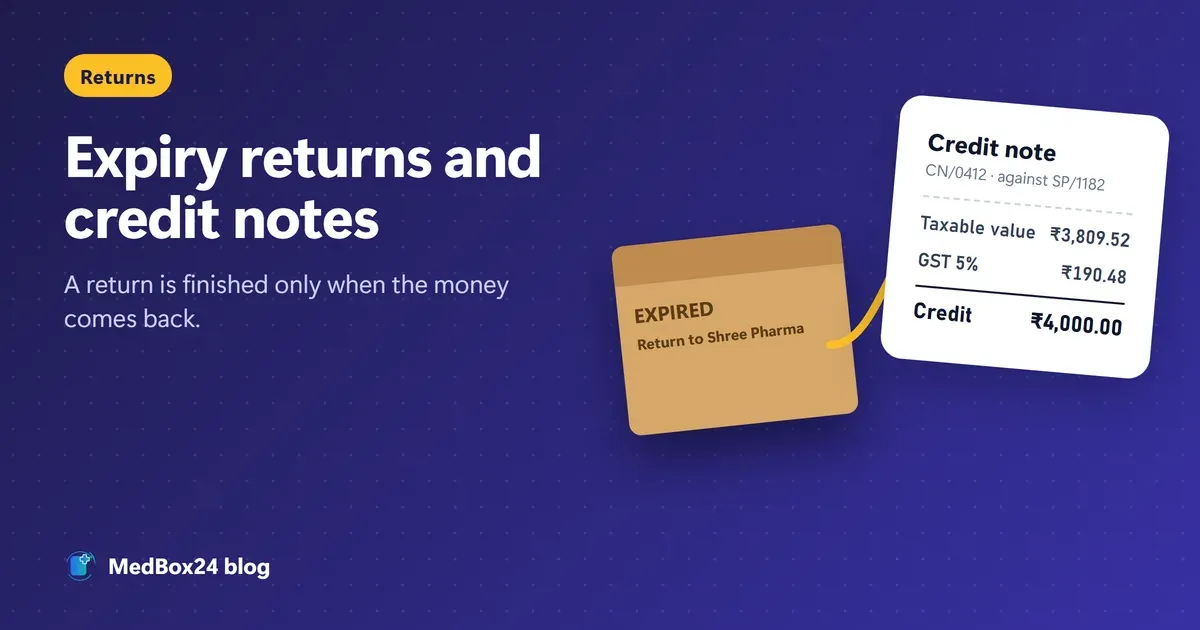
The distributor issues a credit note against your return. Check that it shows:
your GSTIN and theirs,
a reference to the original purchase bills,
each product, quantity and value at the rate you bought it,
the GST on that value, at the rate on the original bill.
A credit note for "goods returned — ₹4,000" with no detail will not help you at the GST stage or in a dispute.
The GST side, in plain words
When you bought the stock, you claimed input tax credit on the GST in the purchase bill. When you return it and the distributor issues a credit note with GST, that credit has to be reduced in your books — because the purchase, in effect, did not happen.
Your distributor reports the credit note in their GSTR-1, and it appears in your GSTR-2B. Your accountant reduces your input credit by that amount in your GSTR-3B. If the distributor never issues the credit note, or issues it without GST, the two sets of books will not match. See GSTR-1 and GSTR-3B for a medical store for the monthly matching routine.
There is also a time limit: a credit note for a financial year has to be issued by 30 November of the following year. Returns sent in October and credited in December can miss it. Do not leave returns to the end of the year.
Making sure the money comes back
Keep a simple return register — or let your billing software do it:
Return date | Distributor | Value sent | Credit note no. | Value credited | Difference |
|---|---|---|---|---|---|
5 Oct | Shree Pharma | ₹4,000 | CN/0412 | ₹4,000 | — |
12 Oct | Ganga Medical Agency | ₹2,350 | — | — | chase it |
20 Oct | City Drug House | ₹1,800 | CDH/CN/88 | ₹1,620 | ₹180 deducted |
Every month, look at returns older than 30 days with no credit note. Call those distributors first. Then look at the "difference" column — a deduction you did not agree to is worth a phone call.
The cheapest return is the one you never make
Every return costs you something: the deduction, the time, the stock that was sitting there unsold. A store that sells near-expiry stock in time and stops buying dead stock has small returns, and small returns are easy to track. Our expiry return calculator shows what a return should bring back.
Run your medical store on MedBox24
Billing, stock, expiry, GST and payroll — on phone and computer. Free trial, no card.
Start free trial