Most medical store owners do not file GST returns themselves. An accountant does it. But the accountant only files what you give them — and if the sales total, the purchase bills or the rates are wrong, the return is wrong too, with your GSTIN on it.
You do not need to become an accountant. You need to know what the two main returns contain, when they are due, and a short routine that hands your accountant clean numbers every month.
The two returns
GSTR-1 is your sales return: what you sold, at which rate, and the HSN summary.
GSTR-3B is your tax return: the tax on your sales, minus the input tax credit on your purchases, and the payment of the difference.
A medical store sells mostly to consumers, so most of GSTR-1 is a summary of B2C sales by tax rate. If you sell to clinics or other businesses with a GSTIN, those bills are shown one by one.
Due dates
You file | Who | Due |
|---|---|---|
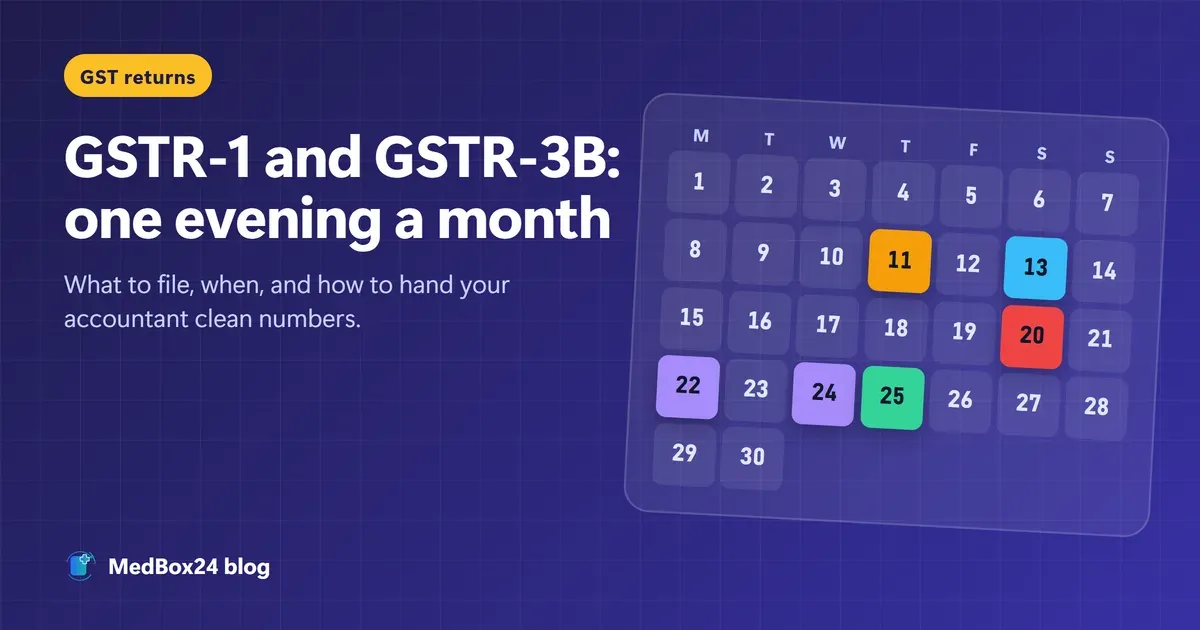
GSTR-1 monthly | Default | 11th of the next month |
GSTR-1 quarterly (QRMP) | Turnover up to ₹5 crore, if you chose QRMP | 13th after the quarter |
IFF (optional) | QRMP filers with B2B bills | 13th of the next month, for months 1 and 2 |
GSTR-3B monthly | Default | 20th of the next month |
GSTR-3B quarterly (QRMP) | QRMP filers | 22nd or 24th after the quarter, depending on your state |
Tax payment PMT-06 | QRMP filers, months 1 and 2 | 25th of the next month |
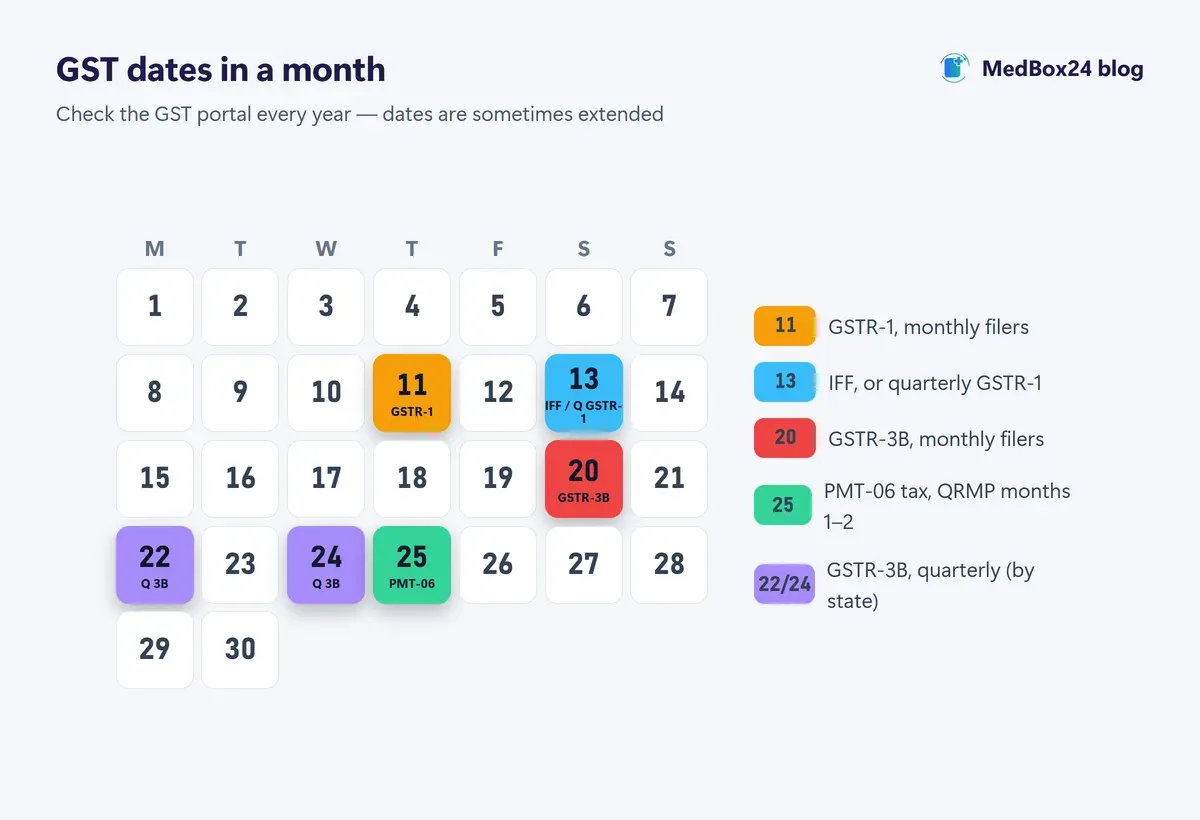
Most small stores choose QRMP — quarterly returns, monthly tax — because it means four sets of returns a year instead of twelve. Check the latest dates on the GST portal every year; they are occasionally extended.
Late filing costs a late fee for every day, and late tax payment costs 18% a year interest. Neither is huge in a single month. Both add up, and both are avoidable.
The input tax credit rule that catches stores
You can claim credit only for purchase bills that your distributor has reported in their own GSTR-1. Those appear in your GSTR-2B, a statement the portal makes for you every month.
If a distributor files late or makes a mistake, the bill does not appear in your 2B, and you cannot claim that credit this month — even though you have the bill in your hand and paid the GST on it.
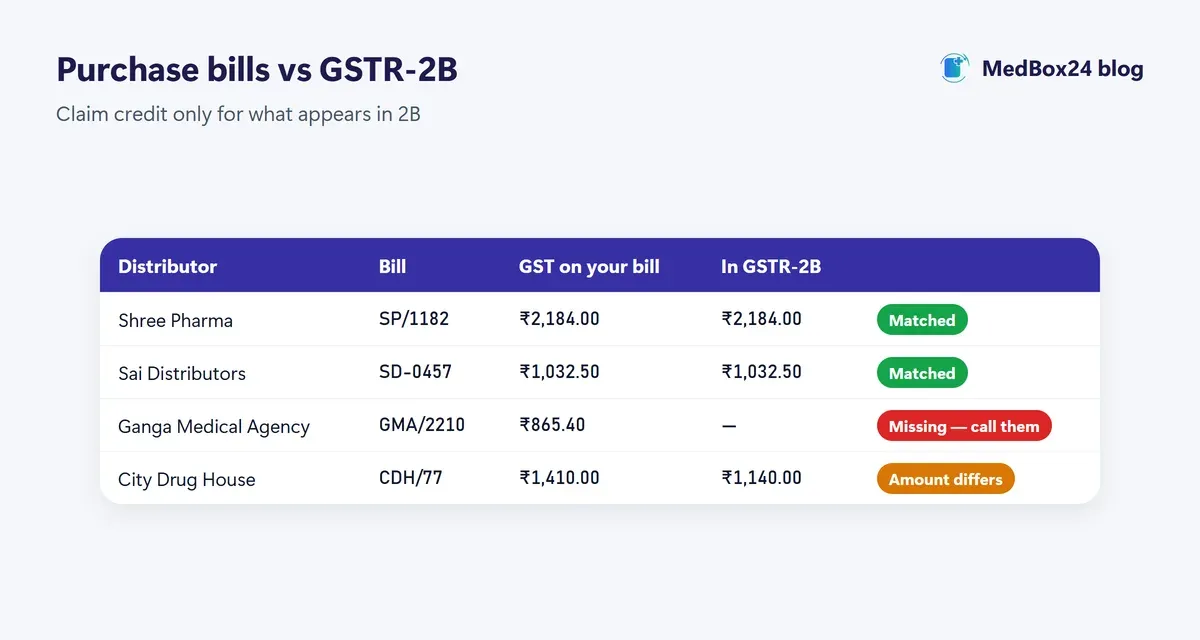
So every month, match your purchase register against GSTR-2B. For anything missing, call the distributor before the 3B is filed.
One evening a month: the routine
In the first week of the month:
Close last month's sales. Total sales by GST rate — 5%, nil, 18% and so on — from your billing software. Check the total against your daily cash and UPI records.
Check returns and credit notes. Sale returns reduce your sales; make sure each one has a credit note.
List your purchase bills with their GST.
Download GSTR-2B and match it with your purchase list. Mark what is missing.
Call the distributors whose bills are missing or wrong.
Send your accountant the sales summary by rate, the HSN summary, the B2B bills (if any) and the matched purchase list.
If your billing software gives you a GSTR-1 ready summary and a GSTR-3B summary, steps 1 and 3 take minutes. If you bill by hand, they take the evening.
Three mistakes to check before filing
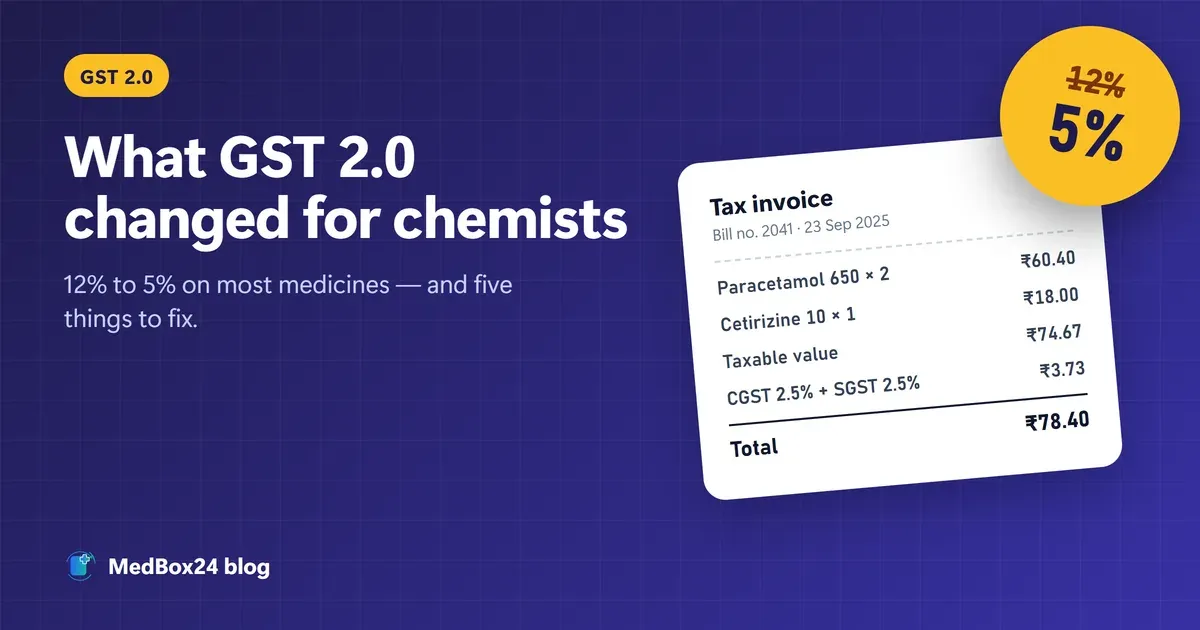
Old GST rates. After 22 September 2025 most medicines are at 5%. A product still set at 12% in your system shows up as wrong tax in your return. Our post on GST 2.0 for chemists has the list.
Missing HSN summary. GSTR-1 asks for an HSN-wise summary. Products without an HSN code in your system make this hard; fix them once, at the product.
Cash sales not billed. Every sale belongs on a bill. Unbilled sales make your stock and your returns disagree — and that is the first thing anyone checking will notice.
Should you consider the composition scheme?
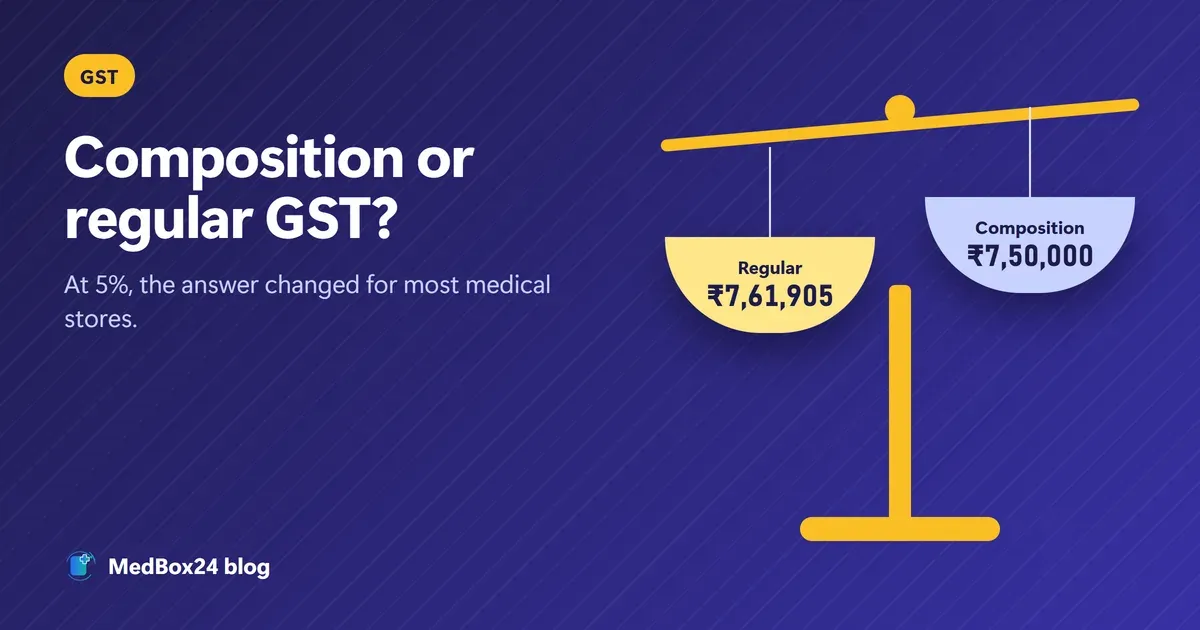
If your turnover is small, the composition scheme has simpler returns and a flat 1% tax, but you cannot claim input credit or charge GST on your bills. Whether it saves money depends on your numbers; we worked it out in composition scheme for a pharmacy.
GST returns are not hard. They are repetitive. A store that does the same small routine every month never has a bad quarter — and an accountant who receives clean numbers charges less for fixing them.
Run your medical store on MedBox24
Billing, stock, expiry, GST and payroll — on phone and computer. Free trial, no card.
Start free trial