For years, a lot of small medical stores were on the GST composition scheme, and for good reason. Pay a flat 1% of turnover, file simple returns, forget about input credit. At 12% GST on medicines, the maths usually favoured it.
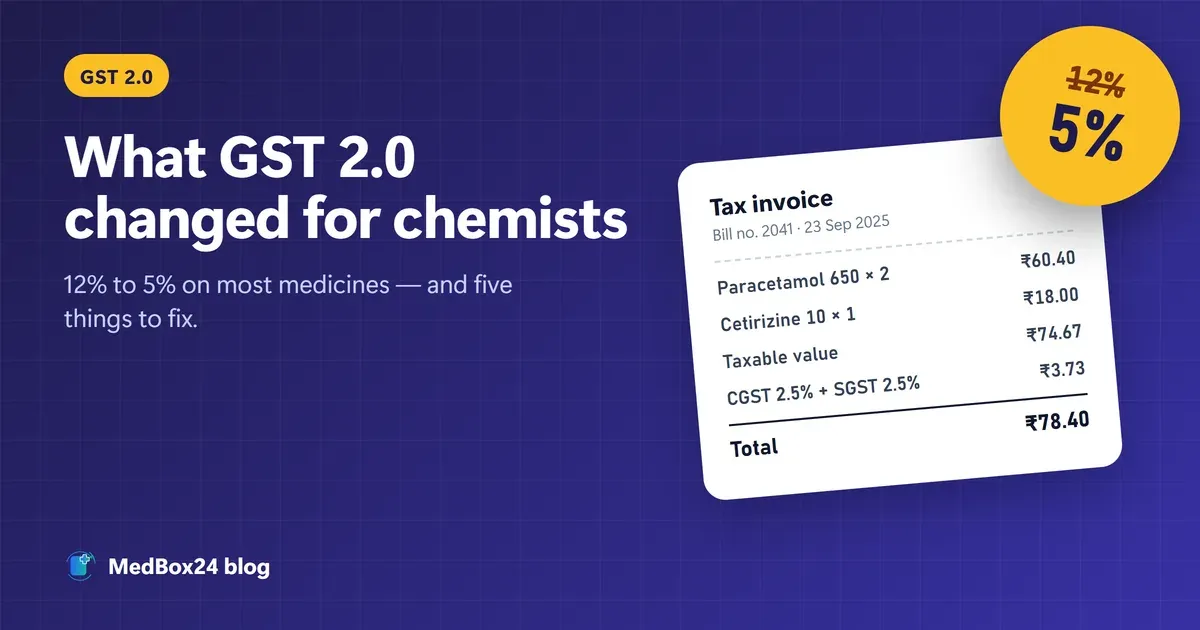
Then on 22 September 2025, most medicines dropped to 5%. That one change quietly flipped the answer for many stores. If you are on composition, or thinking about it, here is how to work it out with your own numbers.
What composition means for a pharmacy
Who can choose it: a store with turnover up to ₹1.5 crore in the previous year (₹75 lakh in some special-category states).
Tax: a flat 1% of turnover (0.5% CGST + 0.5% SGST) for traders.
You cannot charge GST on your bills. You issue a bill of supply, not a tax invoice.
You cannot claim input tax credit on what you buy. The GST on your purchase bills becomes part of your cost.
No sales to other states.
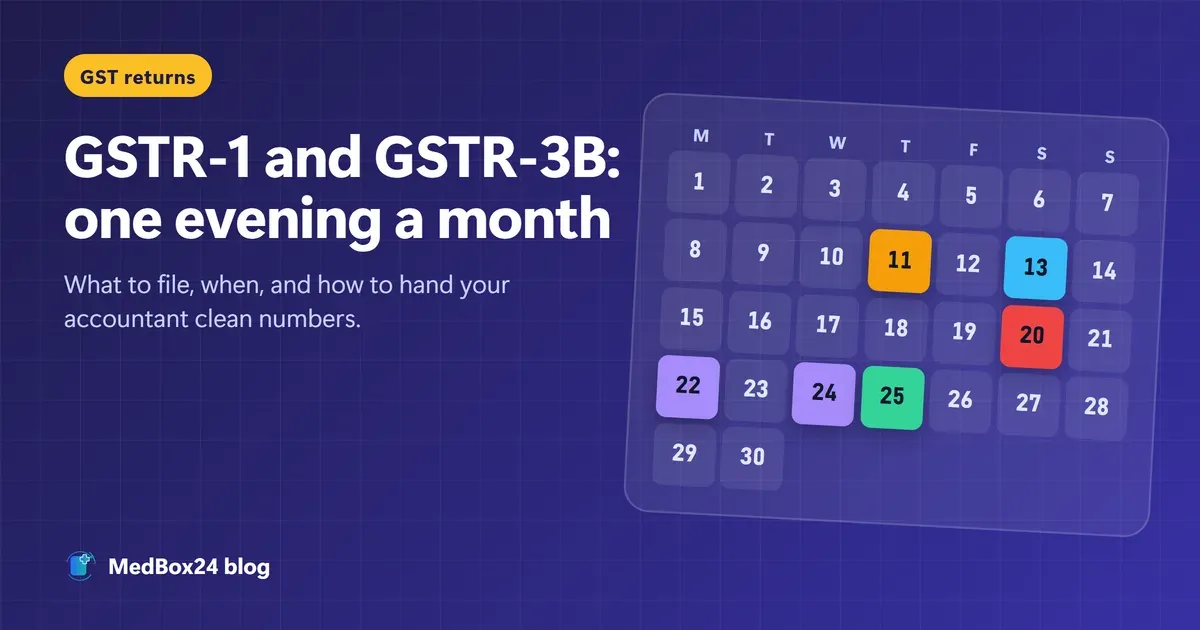
Simpler returns: a quarterly statement and an annual return instead of monthly GSTR-1 and GSTR-3B.
The same store, both ways
Take a store that sells ₹50 lakh a year at MRP, mostly medicines at 5% GST, and buys ₹40 lakh worth at PTR (before GST). The customer pays the same MRP either way.
Regular GST | Composition | |
|---|---|---|
Customers pay you | ₹50,00,000 | ₹50,00,000 |
You pay distributors (PTR + 5% GST) | ₹42,00,000 | ₹42,00,000 |
Input credit you get back | ₹2,00,000 | None |
Tax you pay the government | ₹2,38,095 output − ₹2,00,000 credit = ₹38,095 | 1% of ₹50 lakh = ₹50,000 |
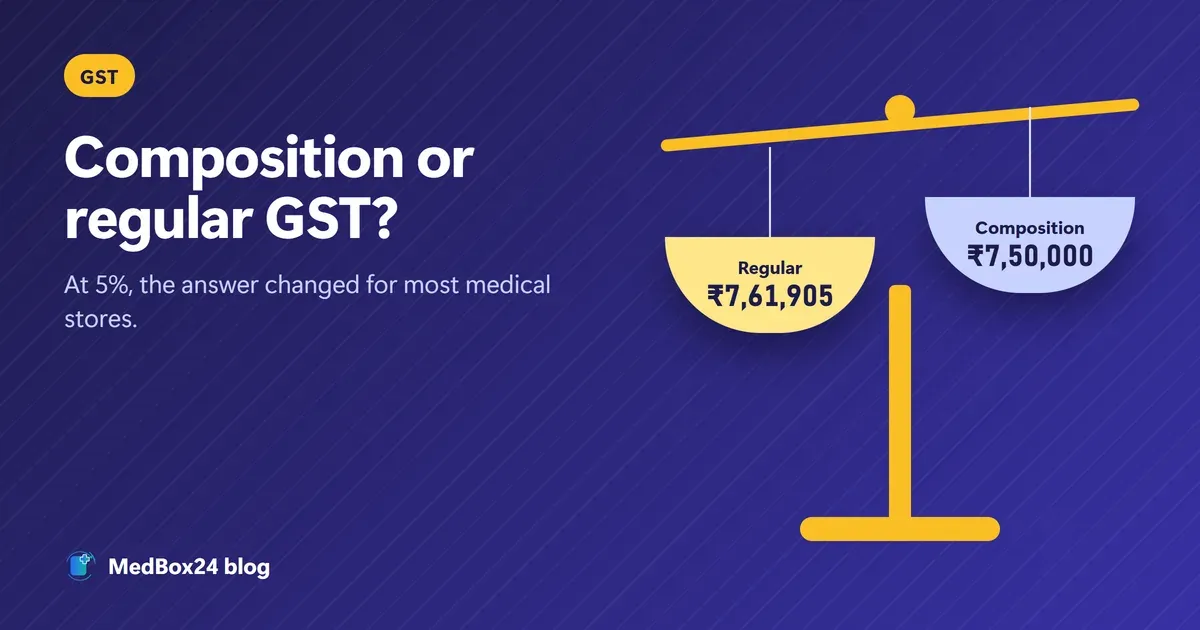
What you keep | ₹7,61,905 | ₹7,50,000 |
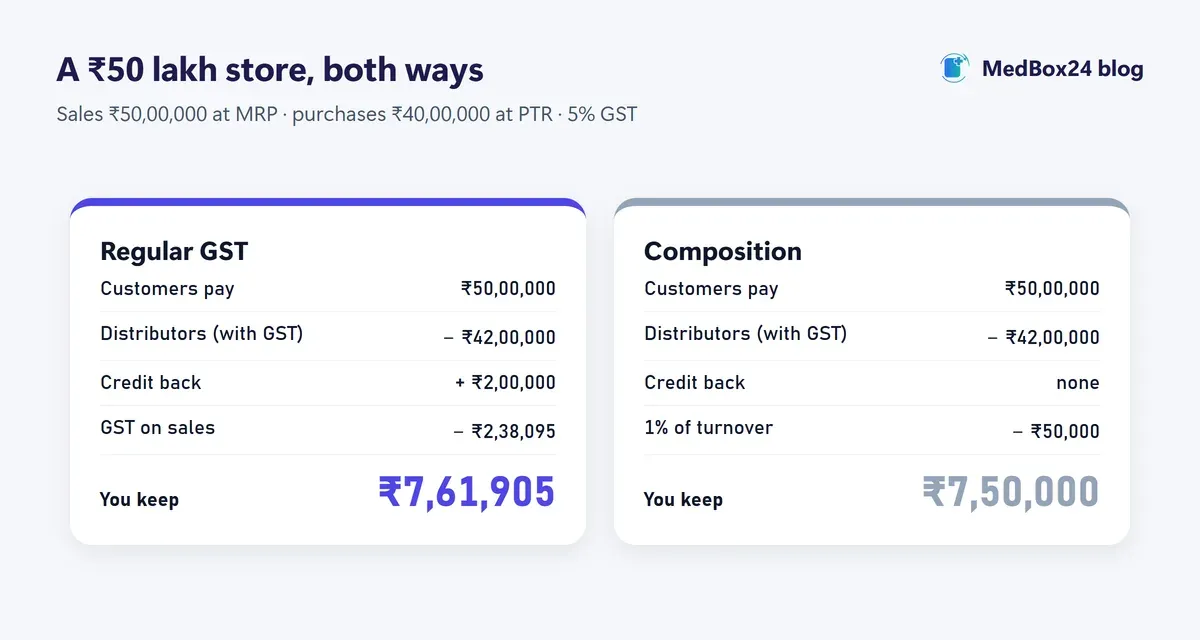
At 5%, regular GST leaves this store ₹11,905 a year more.
Why it was different at 12%
At 12%, the same store's GST under regular would have been about 12% of its margin. Composition's 1% of turnover was smaller for almost every store, unless margins were very thin.
At 5%, regular GST is only about 5% of your margin. Composition is still 1% of your whole turnover. So now composition wins only when your margin is high — roughly when what you earn is more than about a fifth of your sales before GST.
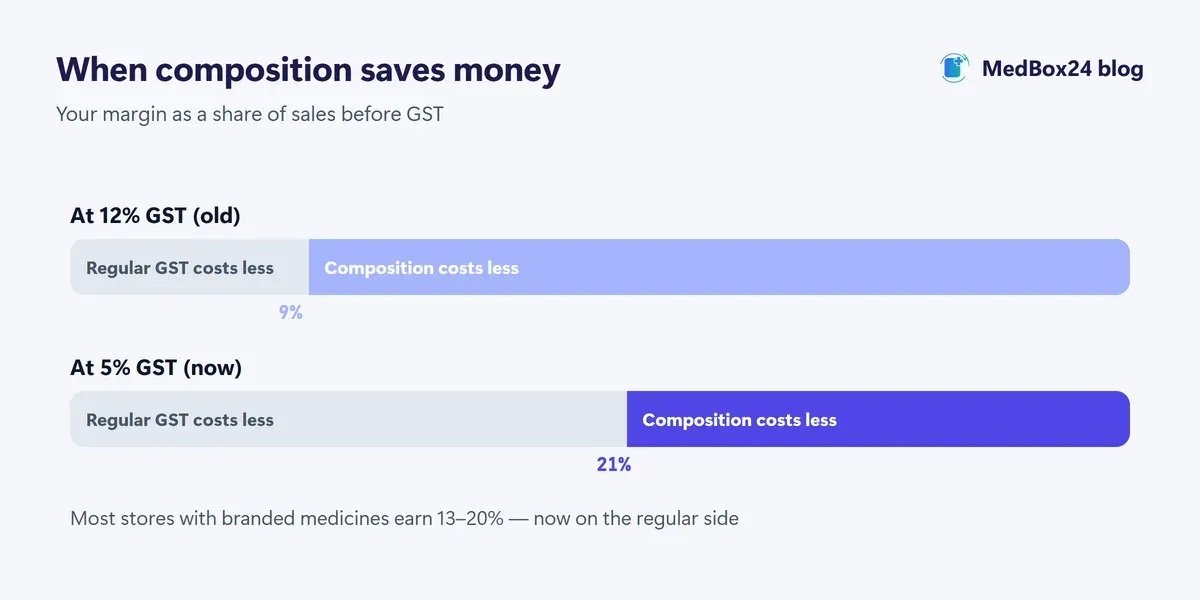
GST rate on your medicines | Composition saves money when your margin on sales before GST is above about |
|---|---|
12% (before 22 Sept 2025) | 9% |
5% (now) | 21% |
A typical store with mostly branded medicines earns 13–20%; we worked this out in how much a medical store really earns. For such a store, regular GST is now the better deal. A store selling mostly high-margin generics may still do better on composition.
Things the numbers do not show
Clinics and businesses cannot claim credit on your bill if you are on composition. If you supply to a nursing home or a doctor's clinic with a GSTIN, they may prefer a supplier who gives a tax invoice.
Accountant's fees. Composition returns are simpler. If your accountant charges much less for composition, add that saving to the composition side.
Nil-rated life-saving medicines and other rates change the picture slightly. Use your real sales by rate, not an assumption.
Switching is done at the start of a financial year with a form on the GST portal; leaving composition can be done during the year. Check the current rules with your accountant before you switch.
Work it out with your own year
Take last year's numbers: total sales, total purchases before GST, and the GST on those purchases. Put them in the table above. If the difference is a few thousand rupees, choose whichever is simpler for you. If it is more, the table has made the decision for you — and it is worth redoing every year, because your product mix, and the rates, keep changing.
If you move to regular GST, our post on GSTR-1 and GSTR-3B for a medical store has the monthly routine.
Run your medical store on MedBox24
Billing, stock, expiry, GST and payroll — on phone and computer. Free trial, no card.
Start free trial