Elderly patients, new mothers, families where everyone works — many of your regular customers would rather send a WhatsApp message than come to the counter. Online pharmacies have taught them to expect delivery. A neighbourhood store that delivers keeps those customers; one that does not slowly loses them.
Delivery is good business. It also carries risks a counter sale does not, because the pharmacist never sees the patient. Here is how to do it properly.
The sale still happens at your store
Think of delivery as a counter sale where the customer is not standing in front of you. Everything that applies at the counter still applies:
The medicine is sold from your licensed premises, by or under your registered pharmacist.
Prescription medicines need a prescription. A photo on WhatsApp lets you check it before packing; keep a copy, and ask to see the original at delivery for anything you are unsure about.
Schedule H1 sales go into the register, the same as at the counter. See Schedule H, H1 and X.
The bill goes with the medicine, with batch and expiry on it.
Rules for online pharmacies have been under discussion for years, and your state's drug control department may have its own instructions for delivery. If you are planning delivery at scale, ask them first.
What should never go out for delivery
Schedule X medicines. Keep these strictly at the counter, against the duplicate prescription, if you stock them at all.
Prescription medicines without a valid prescription, however regular the customer.
Anything where the pharmacist needs to see or talk to the patient first — a first-time antibiotic for a child, an unclear prescription, a dose that looks wrong. Call the customer before you pack.
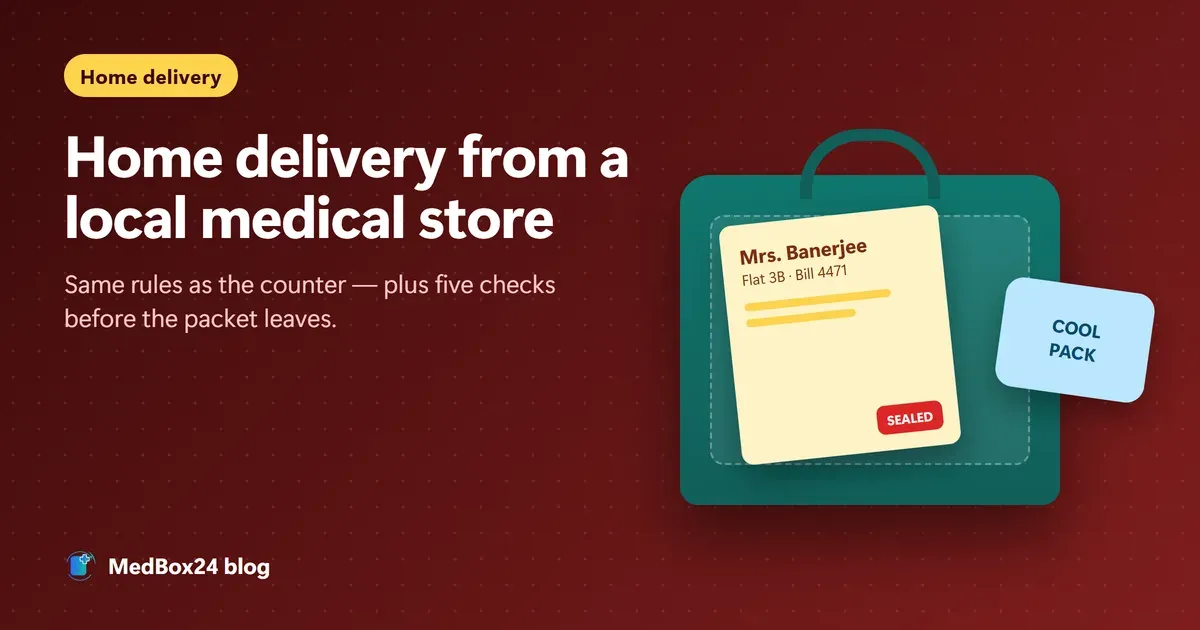
Before the packet leaves
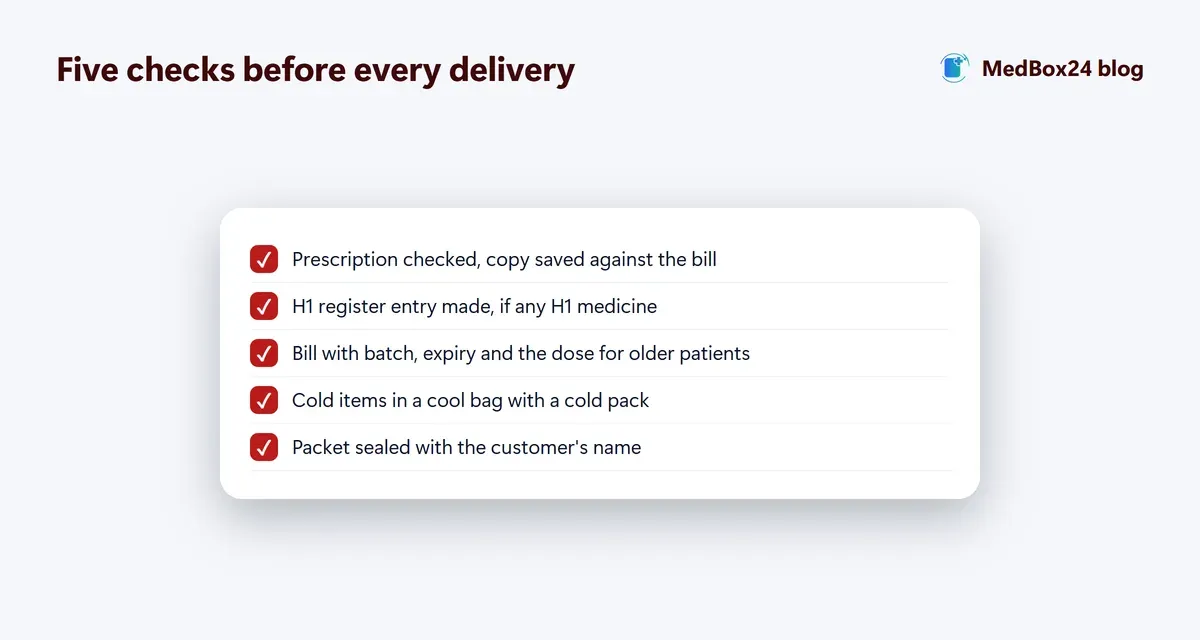
Prescription checked and a copy saved against the bill.
H1 entry made, if any H1 medicine is in the order.
Bill printed with batch, expiry and the dose written for older patients.
Cold items packed in a cool bag with a cold pack — never loose in a delivery bag in summer. See storing insulin and vaccines.
Packet sealed with the customer's name on it, so the delivery person cannot mix up two orders.
The delivery person
Whoever delivers should hand over the packet and collect payment — nothing more. No advice on doses, no substitutions on the doorstep. If the customer has a question, they call the pharmacist. Make this clear to every delivery person.
Payment
UPI on delivery is easiest. Ask the customer to pay to your store's QR or UPI ID, and check that the money has actually arrived in your account before the delivery person leaves — not a screenshot on the customer's phone. A screenshot can be faked in seconds; your bank app or sound box cannot.
Keep it local
A neighbourhood store delivers within its neighbourhood: a few kilometres, the same day. That is where you have the advantage over a large online pharmacy — speed, a familiar face, and a pharmacist the customer can call. Do not try to compete beyond that.
Done this way, delivery turns your best regular customers into permanent ones. It also connects naturally to refill reminders: the message that says "your BP medicine is due" can end with "shall we deliver it this evening?"
Run your medical store on MedBox24
Billing, stock, expiry, GST and payroll — on phone and computer. Free trial, no card.
Start free trial