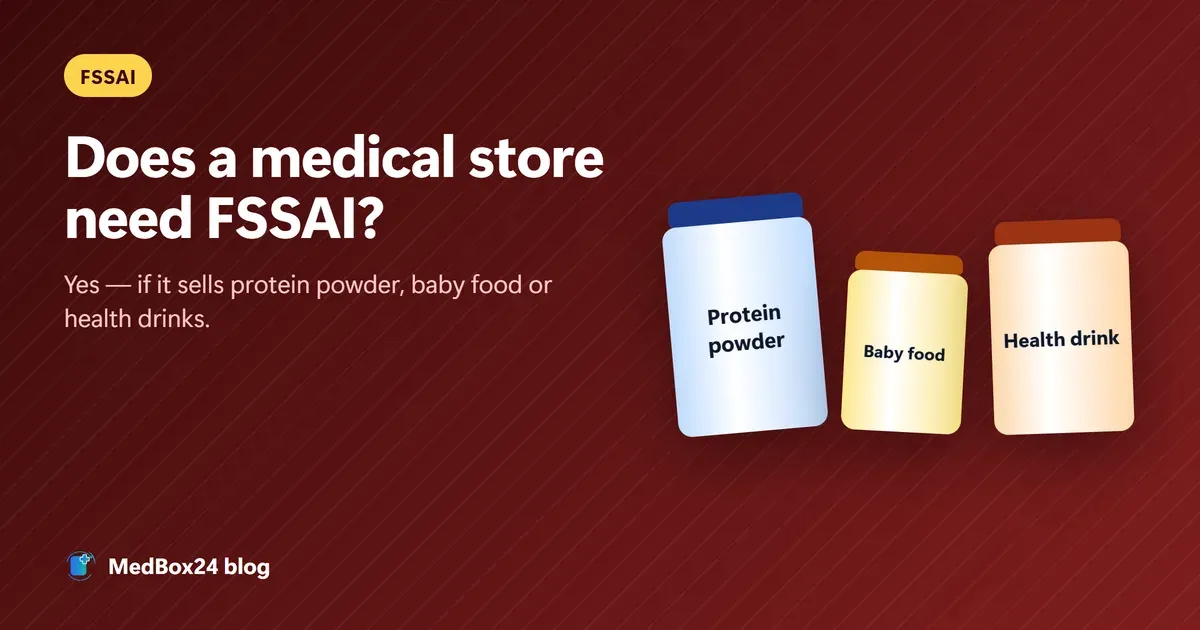
Your drug licence covers medicines. It does not cover food. And a surprising amount of what a medical store sells is food under the law: protein powders, health drinks, baby food, glucose powder, nutrition supplements, diabetic snacks, even some "herbal" products.
Selling food needs registration with the Food Safety and Standards Authority of India (FSSAI). Many chemists only find this out when a food safety officer — not a drug inspector — walks in.
What counts as food in a pharmacy
Protein powders and sports nutrition
Health drinks and malt-based drinks
Infant food and baby cereals
Glucose powder and energy drinks
Nutraceuticals and dietary supplements sold as food (not as medicines)
Sugar-free and diabetic foods, honey, herbal teas
A simple test: if the pack carries an FSSAI licence number and logo instead of a drug manufacturing licence number, it is sold as food.
Registration or licence?
FSSAI has levels based on the turnover of your food business — the food you sell, not your medicine sales.
Your yearly food sales | What you need |
|---|---|
Up to ₹12 lakh | Basic registration — simple, low fee |
₹12 lakh to ₹20 crore | State licence |
Above ₹20 crore | Central licence |
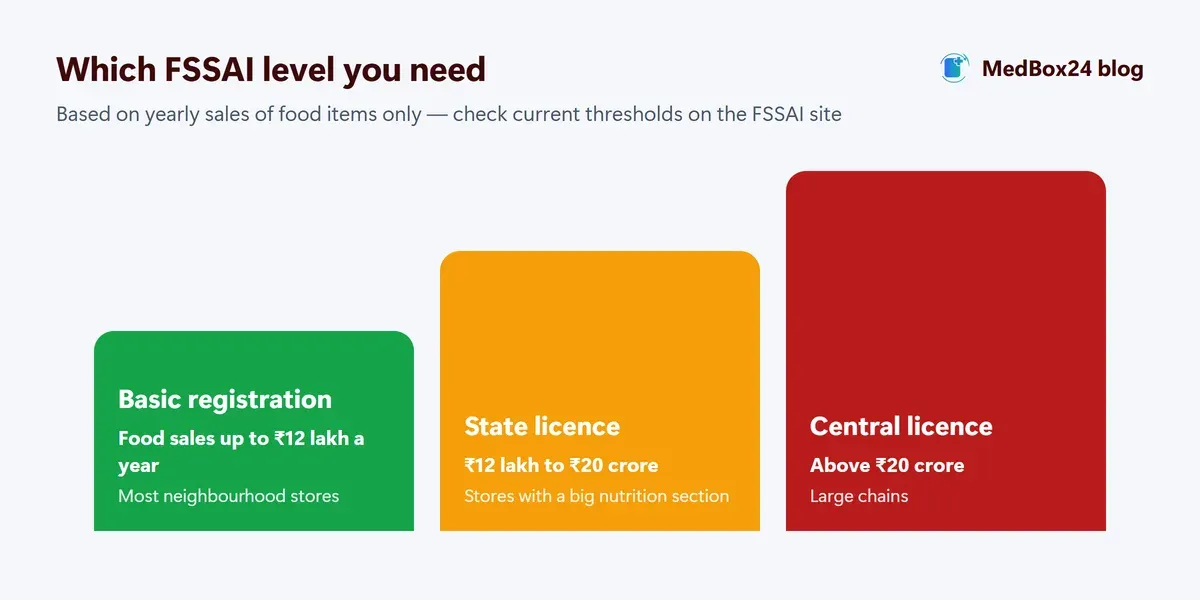
Most neighbourhood medical stores need only the basic registration, because food is a small part of their sales. A store with a big nutrition section may cross ₹12 lakh and need the state licence. Check the current thresholds and fees on the FSSAI website before you apply; they are revised from time to time.
How to apply
Go to FSSAI's online licensing portal (FoSCoS).
Choose registration or licence based on your expected food sales.
Select your business as a retailer.
Upload identity proof, address proof of the premises and a photo.
Pay the fee. Basic registration is usually granted quickly.
Display the registration certificate in the store, next to your drug licence, and renew it before it expires.
Keep food and medicine records apart
Store food items as the label says — many protein powders and health drinks need a cool, dry place, away from direct sun.
Expiry matters here too. Food items are often bought in bigger quantities on schemes, and they expire just like medicines. The near-expiry routine applies to them as well.
GST rates differ from medicines. See GST on everything else a pharmacy sells.
Is it worth it?
For a few hundred rupees and a short online form, the basic registration lets you keep a profitable shelf legally. Protein powders and baby food often carry better margins than medicines and bring in customers who are not ill. It is one of the easiest pieces of paperwork in the business — as long as you do it before someone asks.
Run your medical store on MedBox24
Billing, stock, expiry, GST and payroll — on phone and computer. Free trial, no card.
Start free trial