Most medical stores order by looking at the shelf. If it looks empty, order. If it looks full, do not. It works, mostly — until the evening a regular patient's BP tablet is out, or the month you find three cartons of a syrup that sells twice a week.
A reorder level replaces the look with a number. It takes ten minutes to set for your top products, and after that your purchase list almost writes itself.
The formula
For each product you need three things:
Daily sale — how many units you sell on an average day (take the last 30 days and divide by 30).
Order gap — how many days between your orders to that distributor, plus the days the delivery takes.
Safety days — a cushion for a busy week or a late delivery. Two days is enough for most products.
Then:
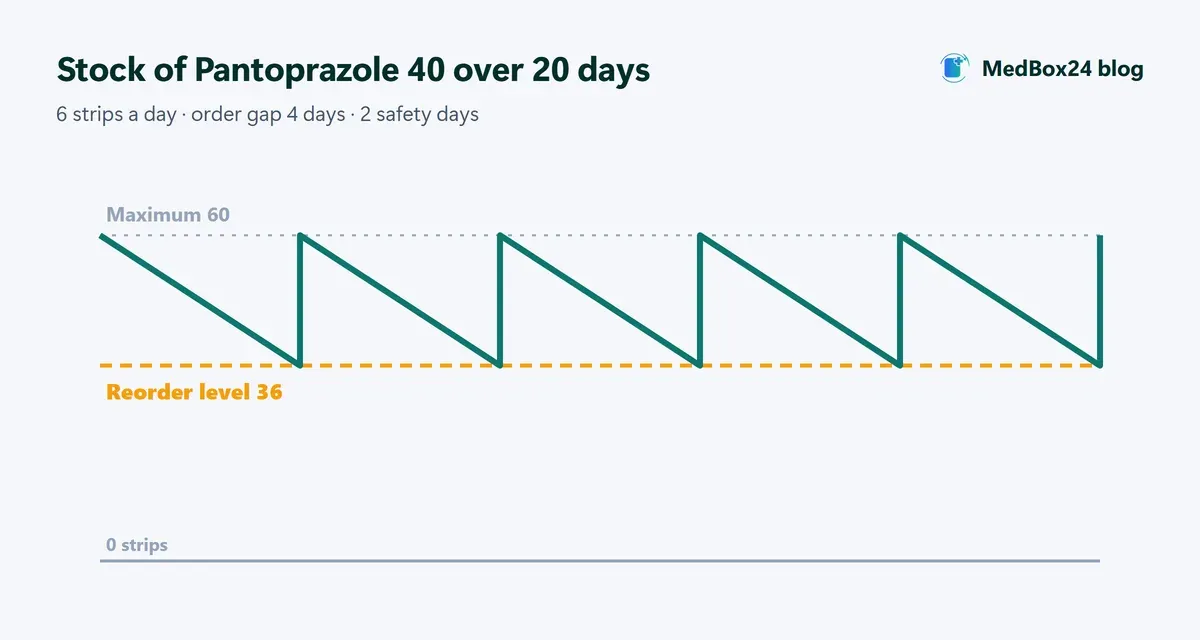
Reorder level = daily sale × (order gap + safety days)
When the stock falls to this number, the product goes on the next order. How much to order? Enough to bring you up to:
Maximum stock = reorder level + daily sale × order gap
Worked out for three products
Say you order from your main distributor every 3 days and it arrives next day: an order gap of 4 days. Safety days: 2.
Product | Daily sale | Reorder level | Maximum | Order when it hits the level |
|---|---|---|---|---|
Pantoprazole 40 (strips) | 6 | 6 × 6 = 36 | 36 + 24 = 60 | about 24 strips |
Metformin 500 (strips) | 10 | 10 × 6 = 60 | 60 + 40 = 100 | about 40 strips |
Cough syrup (bottles) | 1.5 | 1.5 × 6 = 9 | 9 + 6 = 15 | about 6 bottles |
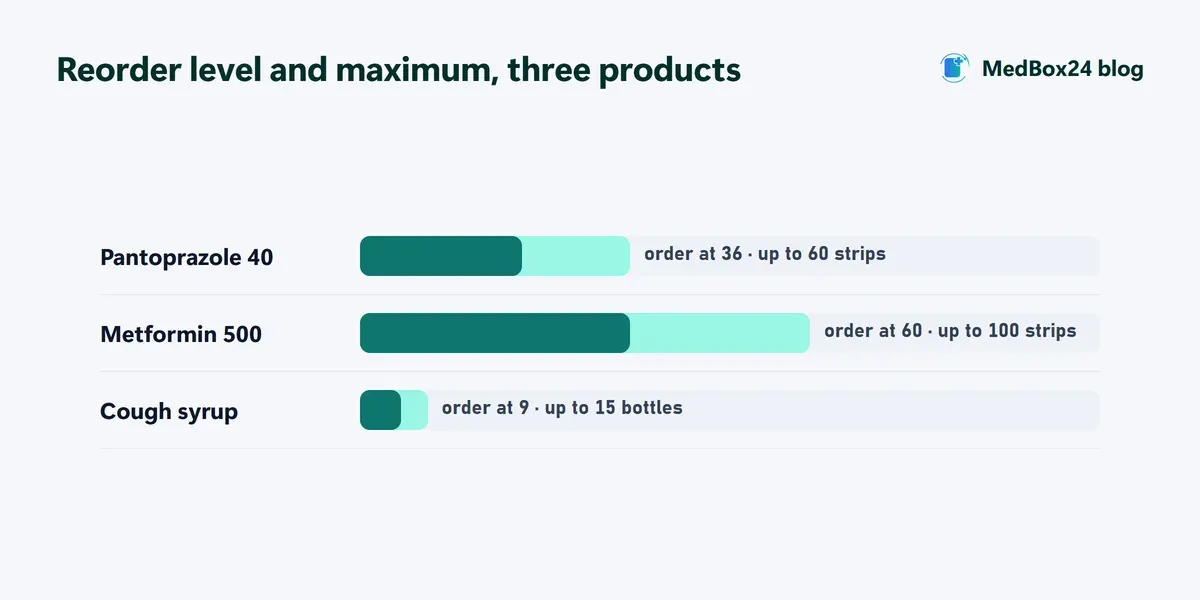
Notice how differently they come out. Metformin needs 100 on hand at most; the syrup needs 15. If you had ordered "one box of each", you would run out of one and overstock the other.
Which products to do first
You do not need a reorder level on all 2,000 products. Start with:
Your top 100 by sales. These are most of your money.
Every regular patient's medicine. Running out of these loses a customer for good. See ways to grow sales.
Products from slow distributors, where a missed order means a week's wait.
Everything else can be ordered on demand.
Adjust with the seasons
Daily sale is not the same all year. Cough syrups, anti-allergy tablets and ORS swing hard between seasons. Recalculate the daily sale for seasonal products every month, or at least at the turn of each season. A reorder level set in January will leave you short of ORS in May.
Avoid the two traps
Do not let schemes override the maximum. A "10+2 this week" deal that takes the syrup to 30 bottles has just put 15 bottles on the shelf for months. That is how dead stock begins.
Watch expiry on slow movers. For a product selling one unit a week, keep the maximum small even if the distributor's minimum pack is bigger.
Let the software do the counting
The formula is simple, but checking 100 products against their levels every day is not. Billing software with batch-wise stock can show a "to order" list of everything below its reorder level, by distributor, ready to send. Then your evening order takes five minutes and nothing important runs out.
Run your medical store on MedBox24
Billing, stock, expiry, GST and payroll — on phone and computer. Free trial, no card.
Start free trial