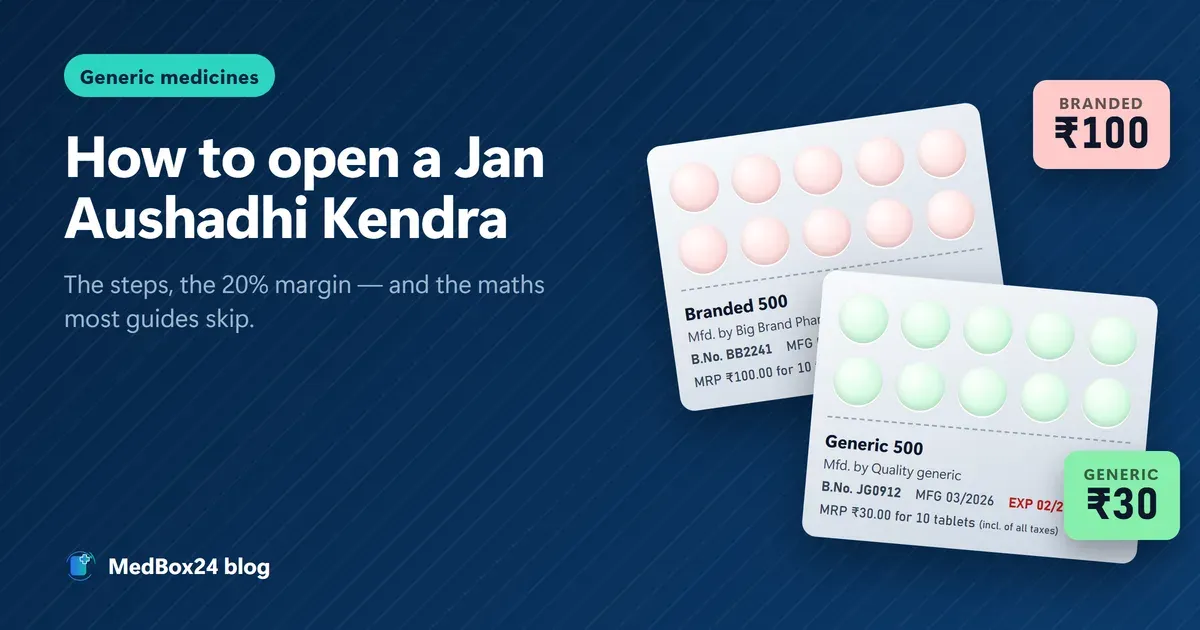
"Jan Aushadhi Kendra kaise khole" is one of the most searched questions about the pharmacy business in India, and for good reason. The scheme has a clear process, a fixed margin and government support, and the medicines it sells are far cheaper than branded ones — which brings customers in.
It is also a different business from a regular medical store. Here are the steps, and then the maths most guides skip.
What it is
Pradhan Mantri Bhartiya Janaushadhi Pariyojana (PMBJP) is run by the Pharmaceuticals & Medical Devices Bureau of India (PMBI) under the Department of Pharmaceuticals. It supplies quality generic medicines to approved stores, called Kendras, which sell them at prices printed on the pack — often a fraction of the branded equivalent. There are already well over 15,000 Kendras across the country.
Who can apply
Individuals with a D.Pharm or B.Pharm, or who will employ a registered pharmacist
NGOs, trusts, societies and hospitals
Special support is offered for women entrepreneurs, divyang applicants, SC/ST applicants, ex-servicemen, and stores in aspirational districts and hilly or north-eastern areas
You need your own or rented space — guides commonly mention about 120 sq ft — and the usual documents: Aadhaar, PAN, proof of the premises, and the pharmacist's registration.
The steps
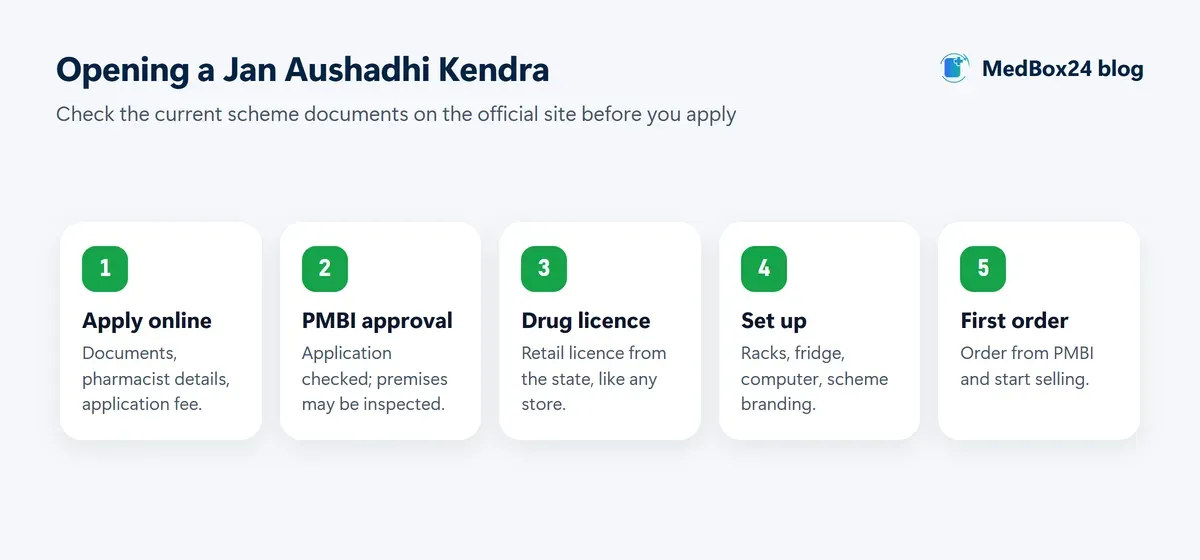
Apply online on the official Janaushadhi website, with the documents and the application fee (waived for some categories).
Get the approval from PMBI. They check the application and may inspect the premises.
Get a retail drug licence for the Kendra from your state drug control department, like any medical store. Our guide on the drug licence for a medical store covers the process.
Set up the store with racks, a fridge, a computer and the branding the scheme requires.
Place your first order with PMBI through their system and start selling.
Rules, fees and incentive amounts change from time to time. Always read the current scheme documents on the official site before you apply — not a blog, including this one.
The margin: 20% of MRP
A Kendra earns a margin of 20% on the MRP of the medicines it sells. On top of that, PMBI offers incentives linked to purchases, with an extra one-time incentive for special categories. The exact amounts and limits are set in the scheme's current procedure.
20% of MRP sounds better than a regular store's margin on price-controlled medicines. But look at what it means in rupees.
The honest maths
Jan Aushadhi medicines are cheap — that is the whole point. So the same patient spends far less at your counter.
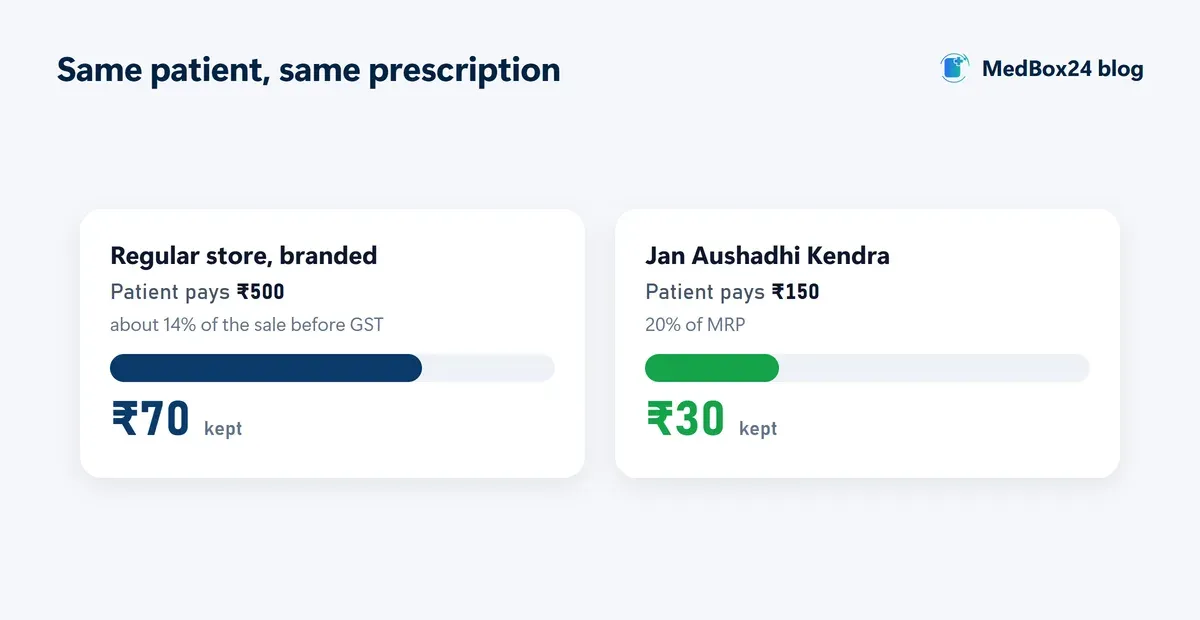
Regular store (branded) | Jan Aushadhi Kendra | |
|---|---|---|
Patient's bill for the same medicines | ₹500 | ₹150 |
Your margin | about 14% of the sale before GST, around ₹70 | 20% of MRP = ₹30 |
To earn what a regular store earns, a Kendra needs two to three times as many customers. That is possible — cheap medicines bring people from far away — but it means a busy counter, a good location near hospitals or dense housing, and tight control of stock and expiry.
What to think about before applying
Location. Near a government hospital, a busy OPD, or a large residential area where people pay for medicines themselves.
Availability. Patients come back only if the medicine is in stock. Track what sells and order on time; a Kendra that often says "not available" loses its regulars.
Doctors. Many prescriptions carry brand names. Your pharmacist must be able to explain the generic equivalent clearly and honestly.
Your name. Only an approved Kendra can use "Jan Aushadhi" on its board. A regular store that does so is misleading customers. If you are still choosing a name, see medical store name ideas.
Is it right for you?
If you want a high-volume, low-ticket store with a fixed margin and the satisfaction of selling medicines people can afford, a Kendra is a good business in the right place. If your area is full of patients who prefer branded medicines and you want higher rupee margins per bill, a regular store may suit you better.
Either way, run the numbers with your own rent and expected footfall — the same way we did for a regular medical store — before you sign anything.
Run your medical store on MedBox24
Billing, stock, expiry, GST and payroll — on phone and computer. Free trial, no card.
Start free trial