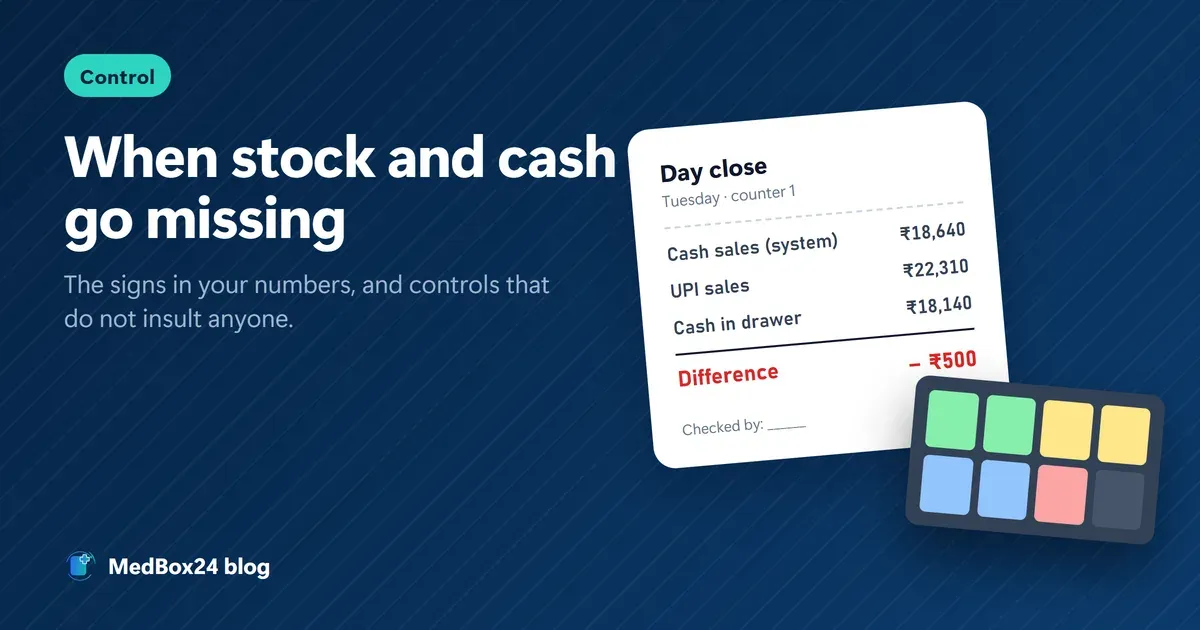
Nobody likes to think it happens in their store. Most owners trust their staff, and most staff deserve it. But when stock and cash are handled by several people all day, small things go missing — sometimes by mistake, sometimes not — and the owner is usually the last to know.
This post is not about catching thieves. It is about running the store so that leakage is hard, easy to spot, and rarely tempting. Good staff prefer it that way too: when the numbers are clear, nobody is suspected.
How leakage happens
Sales without a bill. A customer pays cash for a strip, no bill is made, and the cash goes into a pocket instead of the drawer. The stock is now short, and nothing records why.
Strips walking out. Expensive, small, easy-to-carry items — some injections, branded supplements, cosmetics.
Wrong returns. A "customer return" entered without a customer, and the cash taken out.
Discounts that were not given. The bill shows a discount; the customer paid full price.
Plain mistakes. Wrong change, a strip billed as one when two were given. Not theft, but the same loss.
The signs in your numbers
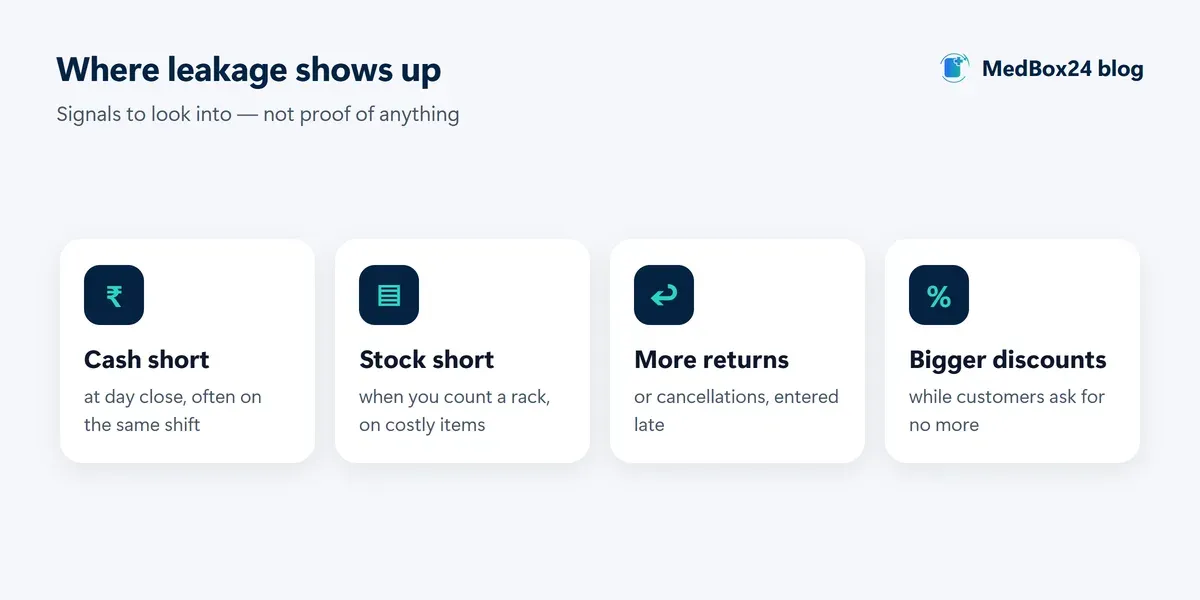
Cash short at day close, often small amounts, often on the same person's shift.
Stock short when you count a rack, especially on expensive, fast-moving items.
Returns and cancellations rising without a reason, or entered late at night.
Average discount going up while customers do not seem to be asking for more.
None of these proves anything. They tell you where to look.
Controls that work
Every sale gets a bill. Make it a store rule, for everyone including the owner. A printed or shared bill is also what the customer needs for returns and for their records. No bill, no sale.
Close the day every day. Count the cash, compare it with the cash sales in your billing system, write down any difference, and sign it. Small differences happen; a pattern of them is a signal. Our guide on daily accounts for a medical store has a simple format.
Count a little, often. Instead of a yearly stock-taking nobody looks forward to, count one or two racks every week, starting with the expensive ones. Differences found within a week are easy to explain. Differences found after a year are not. See the stock audit guide.
Give each person their own login. If everyone bills as "admin", you cannot tell who did what. Separate logins, with the right permissions — who can give discounts, who can cancel a bill, who can take a return — make every action traceable without anyone feeling watched.
Approve the risky actions. Bill cancellations, returns and discounts above a limit can need the owner's or manager's approval. It is a small step that stops most misuse.
One camera over the counter. It protects staff as much as the owner, in a dispute with a customer about change or a missing strip.
When the numbers do not add up
Talk first, in private, with the facts in front of you: dates, amounts, what the system shows. Often there is an honest explanation — a bill made on the wrong batch, a return the owner forgot approving. If there is not, you will usually know from the conversation.
The best control is a store that runs on numbers
Staff behave differently in a store where the owner looks at the day close every evening and asks about a ₹200 difference. Not angrily — just every time. That habit, more than any camera, keeps the drawer and the shelves honest.
Run your medical store on MedBox24
Billing, stock, expiry, GST and payroll — on phone and computer. Free trial, no card.
Start free trial