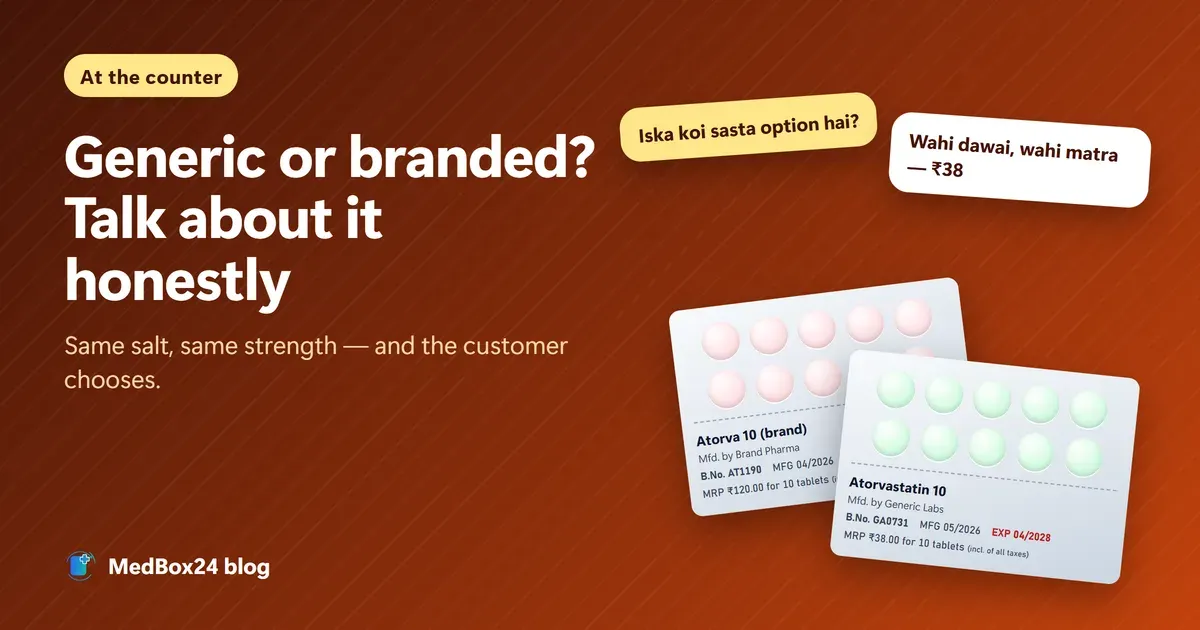
"Iska koi sasta option hai?" More customers ask this every year. They have heard about generic medicines from the news, from Jan Aushadhi Kendras, from relatives who switched. How you answer decides whether they trust your store — and whether they come back.
There are two wrong answers. One is "Nahi, yahi chalega" when a cheaper equivalent exists. The other is swapping the brand without a word. Here is the honest middle.
What a generic is — in one sentence for the customer
"Dawai ka asli naam yeh hai — paracetamol. Yeh brand ek company ka hai, yeh doosra bhi wahi dawai hai, wahi matra, doosri company ki, kam daam mein."
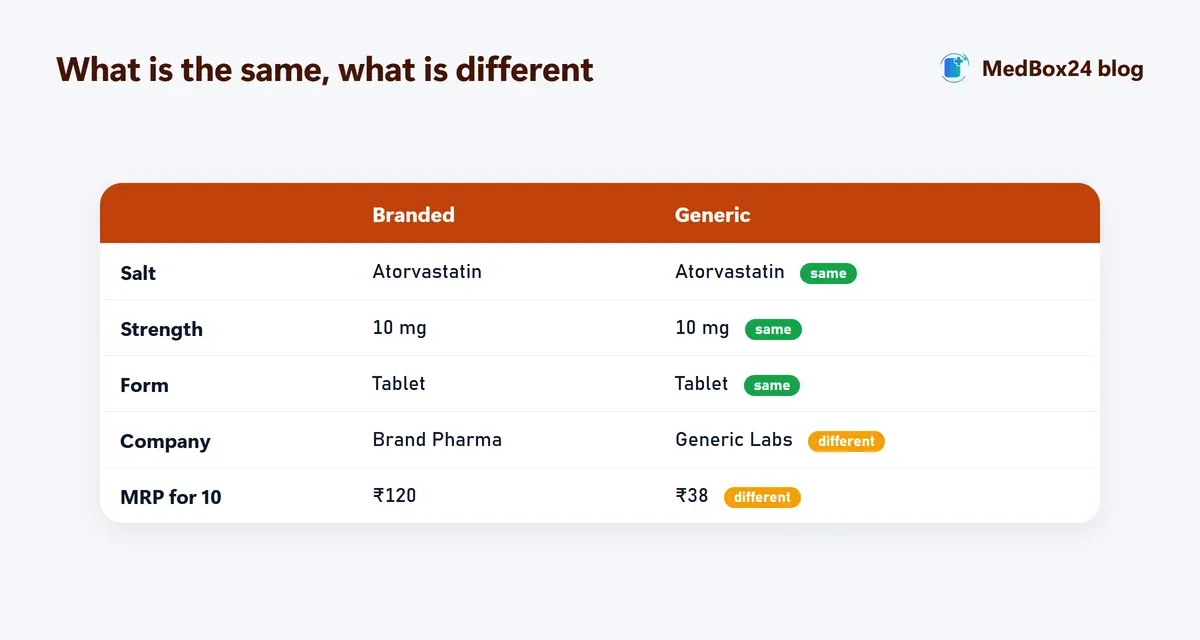
The active ingredient (the salt) and the strength are the same. The company, the price and sometimes the inactive ingredients differ. That is all a customer needs to understand.
When you can offer it
The customer asks for a cheaper option, and
the generic has the same salt and the same strength, in the same form (tablet for tablet, not syrup for tablet), and
it is from a manufacturer you trust and buy through a licensed distributor.
Then show both, tell them the prices, and let them choose.
When to send them back to the doctor
Medicines where small differences matter — some epilepsy, thyroid, heart and transplant medicines. Patients stable on one brand should not be switched without the doctor knowing.
Combination products where you are not sure the generic has exactly the same combination.
Children and the elderly, when in doubt.
Whenever the doctor has written "do not substitute" or the brand is clearly deliberate.
Saying "Doctor se ek baar pooch lijiye" is not losing a sale. It is the answer that makes the customer trust everything else you tell them.
What about your margin?
Generics often carry a higher percentage margin, even though the rupee value of the sale is lower. A store that offers generics honestly usually earns about the same per customer and gains customers who would otherwise go elsewhere. We worked out the numbers for a Jan Aushadhi Kendra in how to open a Jan Aushadhi Kendra, and the same logic applies to generics in a regular store.
What hurts margin is the opposite: refusing to stock any generic, and watching price-conscious customers walk to the store that does.
Stock a small, trusted range
You do not need a generic for every brand. Start with the 50–100 medicines your customers buy most often and most regularly — BP, diabetes, cholesterol, acidity, common antibiotics — and stock one trusted generic for each. Keep them on the same shelf, next to the brand, so the choice is always at hand.
The one rule
Never substitute silently. The customer must know what they are getting and why. A store that explains gets the customer for life. A store that swaps without telling gets found out — usually by the one customer who reads the strip.
Run your medical store on MedBox24
Billing, stock, expiry, GST and payroll — on phone and computer. Free trial, no card.
Start free trial